What is my birth-year element? To determine which element a person's birth year belongs to, East Asian calendrical science pairs the ten Heavenly Stem (thiên can) symbols with the twelve Earthly Branch (địa chi) stations of the lunisolar calendar (âm lịch) birth year to form the sixty-year sexagenary cycle (can chi). From this sixty-year ring, the system maps each consecutive two-year pair to one of thirty Na Yin Five Elements (Ngũ hành nạp âm) identities.
1. Which calendrical principles determine a person's birth-year element?
In traditional Vietnamese culture, a person's birth-year element is determined by matching their lunisolar birth year to the sixty-year sexagenary cycle table. Whenever someone asks which element governs their birth year, classical destiny analysis looks first at the stem-branch pillar of that lunar year rather than the Gregorian calendar date alone.
Within Heavenly Stems and Earthly Branches studies, every lunisolar year is designated by a two-part compound name: the first word is the Heavenly Stem (running from Jia through Gui) and the second word is the Earthly Branch (running from Zi through Hai). Because the lowest common multiple of 10 and 12 is 60, pairing Yang stems exclusively with Yang branches and Yin stems exclusively with Yin branches produces exactly sixty non-repeating year combinations.
The rule that two consecutive lunar years share one Na Yin element and early-year birth notes
Every pair of consecutive lunisolar years, one Yang stem-branch year followed immediately by its adjacent Yin stem-branch year, is grouped under a single Na Yin Five Elements designation, dividing the sixty years evenly into thirty Na Yin identities across the Five Elements (ngũ hành) of Metal, Wood, Water, Fire, and Earth. Furthermore, because the Lunar New Year (Tết Nguyên Đán) typically falls between late January and mid-February on the Gregorian calendar, anyone born before the first day of the first lunar month must look up their birth-year element under the preceding lunisolar year.
Every pair of consecutive lunar years in the 60-year sexagenary cycle shares the exact same natal Na Yin element.
2. How do you use the birth-year, sexagenary cycle, and Na Yin element table (1950 - 2035)?
You can find your exact natal element by locating your lunisolar birth-year pair in the 1950 to 2035 reference table below and reading across to the corresponding stem-branch pair, Na Yin name, and core Five Element. This master lookup table covers both the earlier sixty-year cycle and the current sixty-year cycle so you can check birth years for yourself and your entire family.
Simply match the two-year lunisolar row containing your birth year to see its poetic Na Yin imagery and whether your natal chart (bản mệnh) element belongs to Metal, Wood, Water, Fire, or Earth.
| Lunar Year Pair (Earlier / Later) | Stem and Branch Pair | Na Yin Name | Imagery | Element |
|---|---|---|---|---|
| 1950-1951 / 2010-2011 | Geng Yin and Xin Mao | Pine and Cypress Wood (Tùng Bách Mộc) | Pine timber | Wood |
| 1952-1953 / 2012-2013 | Ren Chen and Gui Si | Long-Flowing Water (Trường Lưu Thủy) | Long river | Water |
| 1954-1955 / 2014-2015 | Jia Wu and Yi Wei | Sand Gold (Sa Trung Kim) | Gold in sand | Metal |
| 1956-1957 / 2016-2017 | Bing Shen and Ding You | Mountain-Foot Fire (Sơn Hạ Hỏa) | Foothill fire | Fire |
| 1958-1959 / 2018-2019 | Wu Xu and Ji Hai | Flatland Wood (Bình Địa Mộc) | Meadow trees | Wood |
| 1960-1961 / 2020-2021 | Geng Zi and Xin Chou | Wall Earth (Bích Thượng Thổ) | Wall plaster | Earth |
| 1962-1963 / 2022-2023 | Ren Yin and Gui Mao | Gold Foil Metal (Kim Bạch Kim) | Pure gold leaf | Metal |
| 1964-1965 / 2024-2025 | Jia Chen and Yi Si | Lamp Fire (Phú Đăng Hỏa) | Oil lamp flame | Fire |
| 1966-1967 / 2026-2027 | Bing Wu and Ding Wei | Heavenly River Water (Thiên Hà Thủy) | Sky rainwater | Water |
| 1968-1969 / 2028-2029 | Wu Shen and Ji You | Great Marsh Earth (Đại Trạch Thổ) | Lowland soil | Earth |
| 1970-1971 / 2030-2031 | Geng Xu and Xin Hai | Hairpin and Bracelet Gold (Thoa Xuyến Kim) | Gold jewelry | Metal |
| 1972-1973 / 2032-2033 | Ren Zi and Gui Chou | Mulberry Wood (Tang Đố Mộc) | Mulberry wood | Wood |
| 1974-1975 / 2034-2035 | Jia Yin and Yi Mao | Great Stream Water (Đại Khê Thủy) | Valley stream | Water |
| 1976-1977 | Bing Chen and Ding Si | Sand Earth (Sa Trung Thổ) | Sandy soil | Earth |
| 1978-1979 | Wu Wu and Ji Wei | Heavenly Fire (Thiên Thượng Hỏa) | Solar fire | Fire |
| 1980-1981 | Geng Shen and Xin You | Pomegranate Wood (Thạch Lựu Mộc) | Pomegranate wood | Wood |
| 1982-1983 | Ren Xu and Gui Hai | Great Sea Water (Đại Hải Thủy) | Ocean water | Water |
| 1984-1985 | Jia Zi and Yi Chou | Sea Gold (Hải Trung Kim) | Deep sea gold | Metal |
| 1986-1987 | Bing Yin and Ding Mao | Furnace Fire (Lư Trung Hỏa) | Kiln fire | Fire |
| 1988-1989 | Wu Chen and Ji Si | Great Forest Wood (Đại Lâm Mộc) | Forest trees | Wood |
| 1990-1991 | Geng Wu and Xin Wei | Roadside Earth (Lộ Bàng Thổ) | Pathway soil | Earth |
| 1992-1993 | Ren Shen and Gui You | Sword-Edge Metal (Kiếm Phong Kim) | Sword steel | Metal |
| 1994-1995 | Jia Xu and Yi Hai | Mountain-Top Fire (Sơn Đầu Hỏa) | Peak fire | Fire |
| 1996-1997 | Bing Zi and Ding Chou | Ravine Water (Giản Hạ Thủy) | Ravine brook | Water |
| 1998-1999 | Wu Yin and Ji Mao | City-Wall Earth (Thành Đầu Thổ) | Rampart earth | Earth |
| 2000-2001 | Geng Chen and Xin Si | White Wax Metal (Bạch Lạp Kim) | Molten metal | Metal |
| 2002-2003 | Ren Wu and Gui Wei | Willow Wood (Dương Liễu Mộc) | Willow timber | Wood |
| 2004-2005 | Jia Shen and Yi You | Spring Water (Tuyền Trung Thủy) | Spring water | Water |
| 2006-2007 | Bing Xu and Ding Hai | Rooftop Earth (Ốc Thượng Thổ) | Roof clay tiles | Earth |
| 2008-2009 | Wu Zi and Ji Chou | Thunderbolt Fire (Tích Lịch Hỏa) | Lightning fire | Fire |
3. How can you mentally calculate your Heavenly Stem, Earthly Branch, and Five Element without a table?
Even without a printed perpetual almanac on hand, you can mentally calculate which sexagenary pair and Na Yin element any lunisolar birth year belongs to using a straightforward two-step addition formula. This mental calculation method comes directly from the fixed mathematical periodicity of the ten stems and twelve branches described in the structure of Heavenly Stems and Earthly Branches.
Finding the Heavenly Stem, Earthly Branch, and converting Na Yin point values
The ten Heavenly Stems map directly to the final digit of the lunisolar birth year: 0 is Geng, 1 is Xin, 2 is Ren, 3 is Gui, 4 is Jia, 5 is Yi, 6 is Bing, 7 is Ding, 8 is Wu, and 9 is Ji. To find the Earthly Branch, subtract 4 from the lunisolar year and divide by 12; the remainder from 0 through 11 corresponds sequentially to the twelve branches from Zi through Hai.
Next, add the assigned point values of the Heavenly Stem and Earthly Branch to determine the year's Five Element:
- Heavenly Stem points: Jia, Yi = 1; Bing, Ding = 2; Wu, Ji = 3; Geng, Xin = 4; Ren, Gui = 5.
- Earthly Branch points: Zi, Chou, Wu, Wei = 0; Yin, Mao, Shen, You = 1; Chen, Si, Xu, Hai = 2.
- Sum the two values (if the total is greater than 5, subtract 5), and match the final number to: 1 = Metal, 2 = Water, 3 = Fire, 4 = Earth, and 5 = Wood.
> Note: When applying this quick mental formula (Stem + Branch), remember the classical point mapping: 1 = Metal, 2 = Water, 3 = Fire, 4 = Earth, and 5 = Wood. For example, the Ding Wei year (2027) has Ding = 2 and Wei = 0, giving a sum of 2, which corresponds to the Water phase, specifically Heavenly River Water.
4. How does the birth-year Na Yin element differ from the Eight Mansions trigram element?
The birth-year Na Yin element and the Eight Mansions trigram element differ because each classical discipline uses its own calculation basis and gender rules for a distinct practical purpose. When looking up their birth-year element across different books or websites, many readers feel confused upon seeing the same birth year listed as Water in one place and Metal or Fire in another.
| Classification System | Calculation Basis | Differentiates Male / Female? | Most Common Practical Application |
|---|---|---|---|
| Na Yin Five Elements (Natal Element) | Lunar birth year Stem and Branch pair (60-year cycle) | No gender difference | Reading baseline temperament on a Zi Wei chart, choosing element-compatible colors, and comparing annual cycles |
| Eight Mansions Trigram (Cung Phi) | Sum of lunar birth-year digits mapped to the Nine Palaces | Differentiates Male / Female | Selecting desk orientation, front door direction, and residential spatial layout |
| Four Pillars Day Master (Bazi) | Heavenly Stem of the birth day weighed against the birth month | No gender difference at the root step | Balancing the Useful God and Favorable Element in Four Pillars analysis |
5. How can knowing your birth-year element be applied in everyday life?
Understanding your birth-year sexagenary pair and natal Na Yin element gives you a practical framework for recognizing personal strengths and organizing your daily environment harmoniously. Below are the two most accessible ways to put your lookup results into practice right away.
Coordinating balanced color palettes and reviewing annual transits
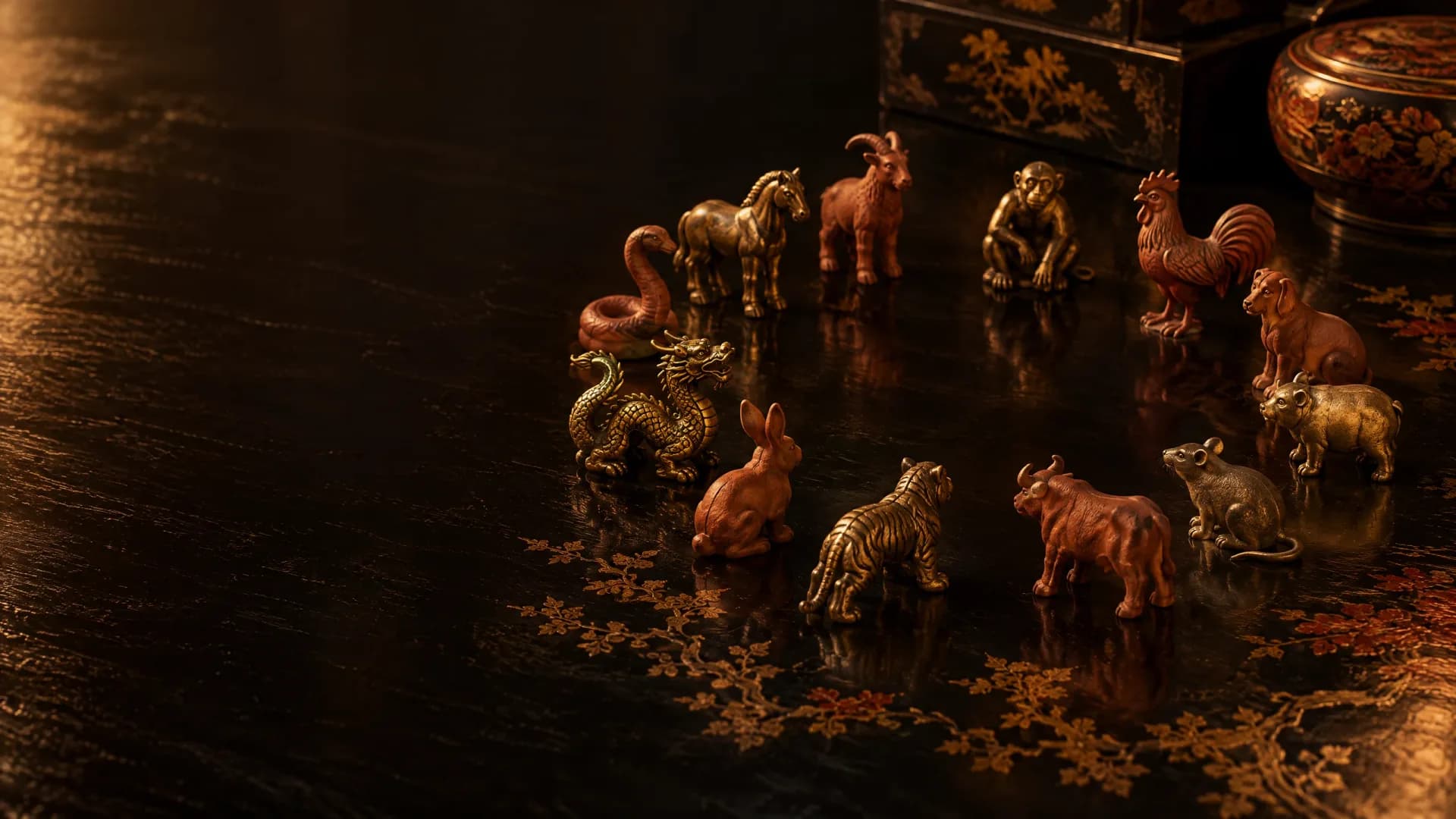
Based on the Five Elements mutual generation and restraint laws, you can favor color tones belonging to your generating element or your own natal element for daily wardrobe choices and workspace decor. At the same time, as each new lunar year approaches, review the order of the 12 zodiac animals together with the Three Harmonies and Four Clashes rules. Combining your natal Na Yin element with the incoming annual transit (lưu niên), such as checking the 2027 Zi Wei overview by birth year, helps you plan household finances and career milestones proactively.
Key points
- A person's birth-year element is calculated from the lunisolar stem-branch pair within the 60-year sexagenary cycle.
- Every two consecutive lunisolar years always share the exact same Na Yin Five Elements identity.
- People born in January or early February on the Gregorian calendar must check the Lunar New Year cutoff date.
- The Na Yin birth-year element is used in Purple Star Astrology (Tử Vi Đẩu Số) and color coordination, and does not vary by gender.
Knowing which element governs your birth year is only the opening step; to gain a complete picture of your career, finances, and family life, Zi Wei Dou Shu also incorporates your lunar birth month, day, and hour to anchor all twelve palaces on your Zi Wei chart (lá số Tử Vi). You can generate a free personal Zi Wei chart to explore a detailed interpretation tailored to your exact birth time.
Frequently asked questions
If I was born in early January on the Gregorian calendar, do I use the old or new lunar year for my element?
You need to check whether your Gregorian birth date fell before or after the first day of the Lunar New Year (Tết Nguyên Đán). In traditional Vietnamese Zi Wei and calendrical practice, anyone born before the first day of the first lunar month has their stem-branch pair and Na Yin element calculated under the preceding lunar year.
Why do a husband and wife born in the same year have different elements when checking house directions?
That happens because directional feng shui under the Eight Mansions system uses the trigram palace (Cung Phi, calculated from gender and the Nine Palaces diagram) rather than the Na Yin element. Under the sixty-year Na Yin Five Elements system, men and women born in the same lunar year share the exact same natal element.
Can two people whose Na Yin elements restrain each other work together effectively?
Yes, they can work together very effectively. Among the thirty Na Yin forms, many pairs whose base elements restrain each other actually complement each other in practice (for example, Sword-Edge Metal requires Furnace Fire to be forged into a sharp tool), and real-world teamwork also depends on communication habits and individual natal charts.
After how many years do the birth-year stem-branch pair and Na Yin element repeat?
The sixty-year sexagenary cycle repeats after exactly 60 lunar years. For instance, both 1967 and 2027 are Ding Wei years and both carry the Na Yin element Heavenly River Water.
Sources
- Wan Minying, San Ming Tong Hui (Compendium of the Three Fates): Classical chapters analyzing the origins and characteristics of the 60 Sexagenary Na Yin Elements.
- Vân Đằng Thái Thứ Lang, New Compendium of Zi Wei Dou Shu: Reference tables for sexagenary cycles, Five-Element Bureaus, and natal Na Yin elements.
- Standardized
NAP_AM_TABLEandCAN_NAMES/CHI_NAMESspecification cross-referenced against the Vietnamese Perpetual Calendar.