What birth inputs are needed before calculation begins?
A complete calculation input consists of birth year, month, day (entered in either Gregorian or lunisolar form), birth hour, and gender. In classical Purple Star Astrology (Tử Vi Đẩu Số) manuals, the four time components establish palace coordinates and star positions around Zi Wei (Tử Vi), while gender paired with the Yin-Yang polarity of the birth-year Heavenly Stem governs whether ten-year decade cycles advance clockwise or counterclockwise.
Birthplace confirms the applicable civil timezone at the moment of birth — an important check for overseas births or for people born in southern Vietnam during 1960–1969, when civil time observed UTC+8 rather than UTC+7 (verify any one-hour shift near an odd-hour boundary). If your recorded birth hour is uncertain, review how birth time affects a Zi Wei chart before locking in a single chart.
| Calculation step | Rule operation | Primary inputs | Output on the chart |
|---|---|---|---|
| Step 1 | Lunisolar & sexagenary conversion | Gregorian date, clock time, timezone | Lunisolar date, four stem-branch pillars, Na Yin Five Elements |
| Step 2 | Anchor 12 palaces & Body Palace | Lunisolar birth month and birth-hour Earthly Branch | Coordinates of Life Palace, Body Palace, and 11 remaining palaces |
| Step 3 | Assign palace stems & Bureau | Birth-year Heavenly Stem (Five Tigers rule) + Life Palace | Water 2nd, Wood 3rd, Metal 4th, Earth 5th, or Fire 6th Bureau |
| Step 4 | Place 14 major stars | Five-Element Bureau number and lunisolar birth day (1–30) | Positions of Zi Wei, Tian Fu, and the other 12 major stars |
| Step 5 | Place auxiliary stars & Transformations | Year, month, day, and hour stems and branches | Support stars, challenging stars, Lu Cun, and Four Transformations |
| Step 6 | Index decade & annual cycles | Bureau number, gender, and year Yin-Yang polarity | Starting lunisolar ages for each ten-year decade cycle |
How are birth date and time converted into the sexagenary cycle?
Traditional calendar math pairs ten Heavenly Stems with twelve Earthly Branches to form the sixty-unit sexagenary cycle, assigning each year a distinct Na Yin Five Elements image recorded on the central Heaven Plate. Clock time is mapped onto twelve two-hour Earthly Branch windows: Zi hour opens at 23:00–00:59, Chou runs 01:00–02:59, Yin runs 03:00–04:59, and so forth through Hai at 21:00–22:59.
Years containing a lunisolar leap month require an explicit rule: some lineages split the leap month at the fifteenth day between the preceding and following months, whereas others assign it to the base month. Transparent chart software documents which leap-month rule is active so two practitioners can reproduce the same grid.
How are the Life Palace and Body Palace located?
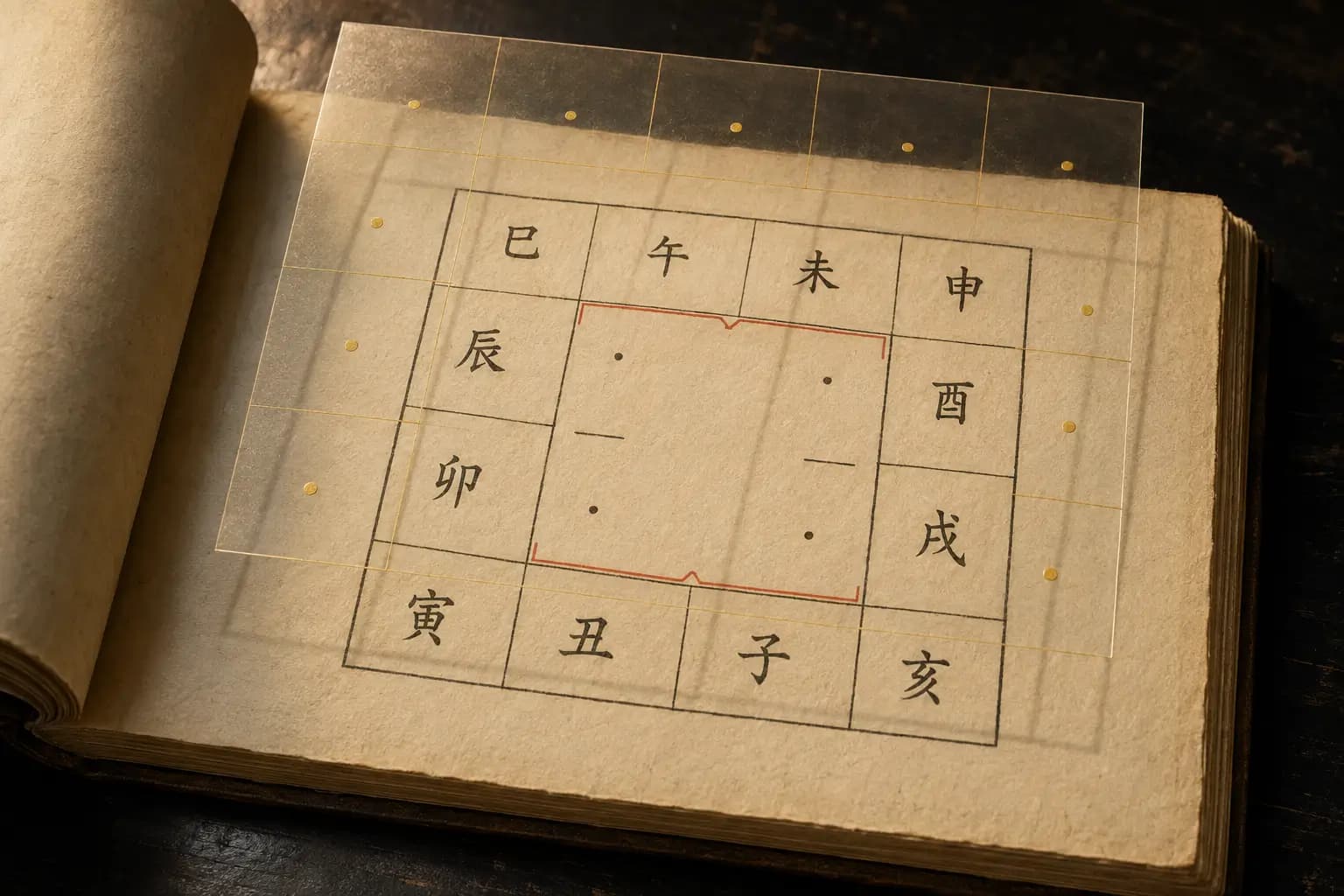
Starting from the Yin branch cell in the lower-left corner as the first lunar month, the calculator counts clockwise to the birth month. Treating that cell as Zi hour, counting counterclockwise to the birth-hour branch locates the Life Palace, while counting clockwise from the same month cell to the birth-hour branch locates the Body Palace.
Once the Life Palace is fixed, the other eleven palaces — Parents, Fortune, Property, Career, Friends, Travel, Health, Wealth, Children, Spouse, and Siblings — follow in unbroken order around the twelve Earthly Branches. Because both counts start from the same month cell, the Body Palace always lands inside one of six structural palaces.
How is the Five-Element Bureau derived and why does it matter?
Using the Five Tigers stem-mapping rule from the birth-year Heavenly Stem, the calculator assigns a Heavenly Stem to the Yin cell and counts around to find the stem-branch pair of the Life Palace. That pair maps to one of five bureaus: Water 2nd Bureau (2), Wood 3rd Bureau (3), Metal 4th Bureau (4), Earth 5th Bureau (5), or Fire 6th Bureau (6).
The bureau integer serves two indispensable roles: dividing the lunisolar birth day by the bureau number locates the pole star Zi Wei, and that same integer sets the lunisolar age at which the first decade cycle begins in the Life Palace. Read more in Life Palace, Body Palace, and Bureau explained and what Mệnh, Cục, and Thân mean.
In what order are the remaining stars placed?
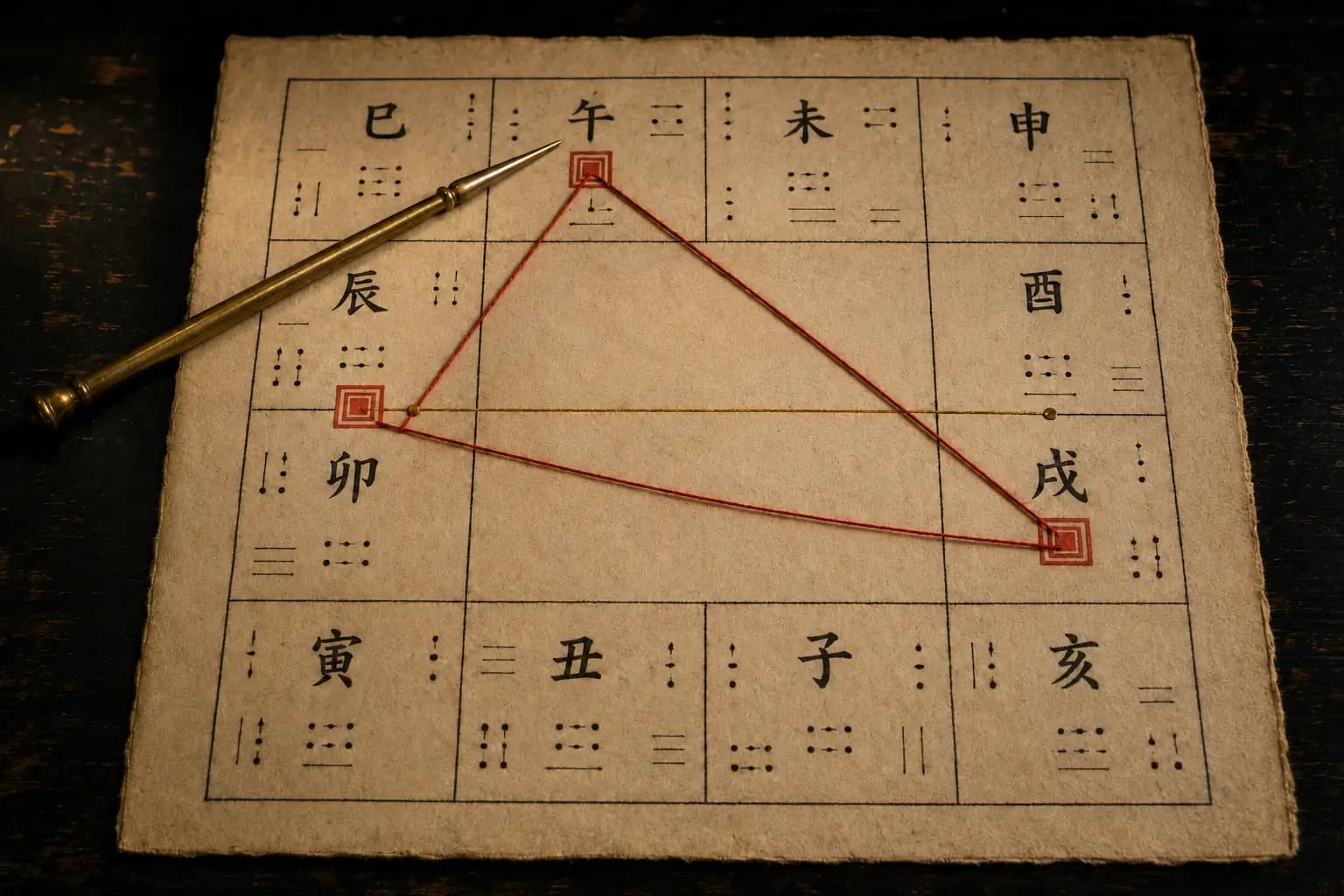
Once Zi Wei is placed, the other five stars of its northern group (Tian Ji, Tai Yang, Wu Qu, Tian Tong, Lian Zhen) step counterclockwise at fixed intervals. Reflecting Zi Wei across the Yin–Shen axis locates Tian Fu, from which the remaining seven southern major stars (Tai Yin, Tan Lang, Ju Men, Tian Xiang, Tian Liang, Qi Sha, Po Jun) step clockwise. See each star's profile in 14 major stars in Purple Star Astrology.
Next, auxiliary stars are placed by their respective time pillars: Lu Cun, Qing Yang, Tuo Luo, Tian Kui, Tian Yue, and the Four Transformations (Hua Lu, Hua Quan, Hua Ke, Hua Ji) derive from the birth-year Heavenly Stem; Zuo Fu and You Bi follow the birth month; Wen Chang, Wen Qu, Di Kong, and Di Jie follow the birth hour; and the twelve Chang Sheng life stages follow the Five-Element Bureau.
How can you verify that a chart was cast properly?
Inspect four items on the Heaven Plate right away: whether the converted lunisolar date matches your Gregorian birthday, whether the two-hour Earthly Branch matches your birth clock time, whether gender polarity is right, and whether the Life Palace matches the month-and-hour count from Yin.
If two calculators differ on one or two minor stars or on the Geng/Ren stem Four Transformations, that difference almost always reflects school-level tables rather than an arithmetic bug. Try casting directly on our Zi Wei chart calculator and continue to how to read a Zi Wei chart for beginners.