Five Elements mutual generation and restriction (Ngũ hành tương sinh tương khắc) is the law of mutual support and restraint among the five energy states: Metal (Kim), Wood (Mộc), Water (Thủy), Fire (Hỏa), and Earth (Thổ). Mutual generation nurtures growth and vitality, while mutual restriction checks excess to maintain dynamic balance.
1. What is the nature of the Five Elements in Eastern philosophy?
In East Asian calendrical science, the Five Elements (ngũ hành) combine "Five" (Ngũ), referring to the five core constituents, and "Elements" or "Movements" (Hành), meaning ceaseless motion and transformation. The five phases of Metal, Wood, Water, Fire, and Earth represent five shifting states of natural energy across the seasons.
When exploring foundational knowledge of the Five Elements and personal destiny, you will see that classical scholars used natural imagery to describe each stream of energy. Through this framework, phenomena ranging from seasonal weather to human temperament are grouped into five distinct affinities.
Five states of movement in nature
The Wood element represents the upward growth of spring and flexible vitality. The Fire element embodies the radiant heat of summer and enthusiastic drive.
The Earth element serves as the central pivot that receives and nourishes all things during seasonal transitions. The Metal element reflects the condensed, solid crystallization of autumn, while the Water element represents the fluid flow of winter alongside adaptable wisdom.
| Element | Core Attribute | Prosperous Season | Direction | Virtue and Quality |
|---|---|---|---|---|
| Wood (Mộc) | Growth, expansion | Spring | East | Benevolence, creativity |
| Fire (Hỏa) | Radiant heat, brightness | Summer | South | Propriety, enthusiasm |
| Earth (Thổ) | Reception, connection | Seasonal transitions | Center | Trustworthiness, composure |
| Metal (Kim) | Condensation, sharpness | Autumn | West | Righteousness, discipline |
| Water (Thủy) | Permeation, storage | Winter | North | Wisdom, depth |
The distinction between foundational Five Elements and Na Yin Five Elements
Beginners often confuse the intrinsic element of an individual Heavenly Stem (thiên can) or Earthly Branch (địa chi) with the birth-year Na Yin Five Elements (Ngũ hành nạp âm) classification. For example, within the sexagenary cycle (can chi), the Jia (Giáp) stem belongs to Wood and the Zi (Tý) branch belongs to Water, yet combining them into the Jia Zi (Giáp Tý) year produces the Na Yin element of Sea Gold (Hải Trung Kim).
To understand how these stem-branch pairings work in detail, read our guide on what Na Yin is and the table of 30 Na Yin elements. Distinguishing between these two layers of the Five Elements prevents mechanical misapplication when checking age compatibility or reading a chart.
2. In what order does Five Elements mutual generation unfold?
Mutual generation (tương sinh) means one element nourishes, supports, and promotes another element so it can grow stronger. Within every generative pair, there is always the parent element that generates the self (incoming generation, or Sinh nhập) and the child element that the self generates (outgoing generation, or Sinh xuất).
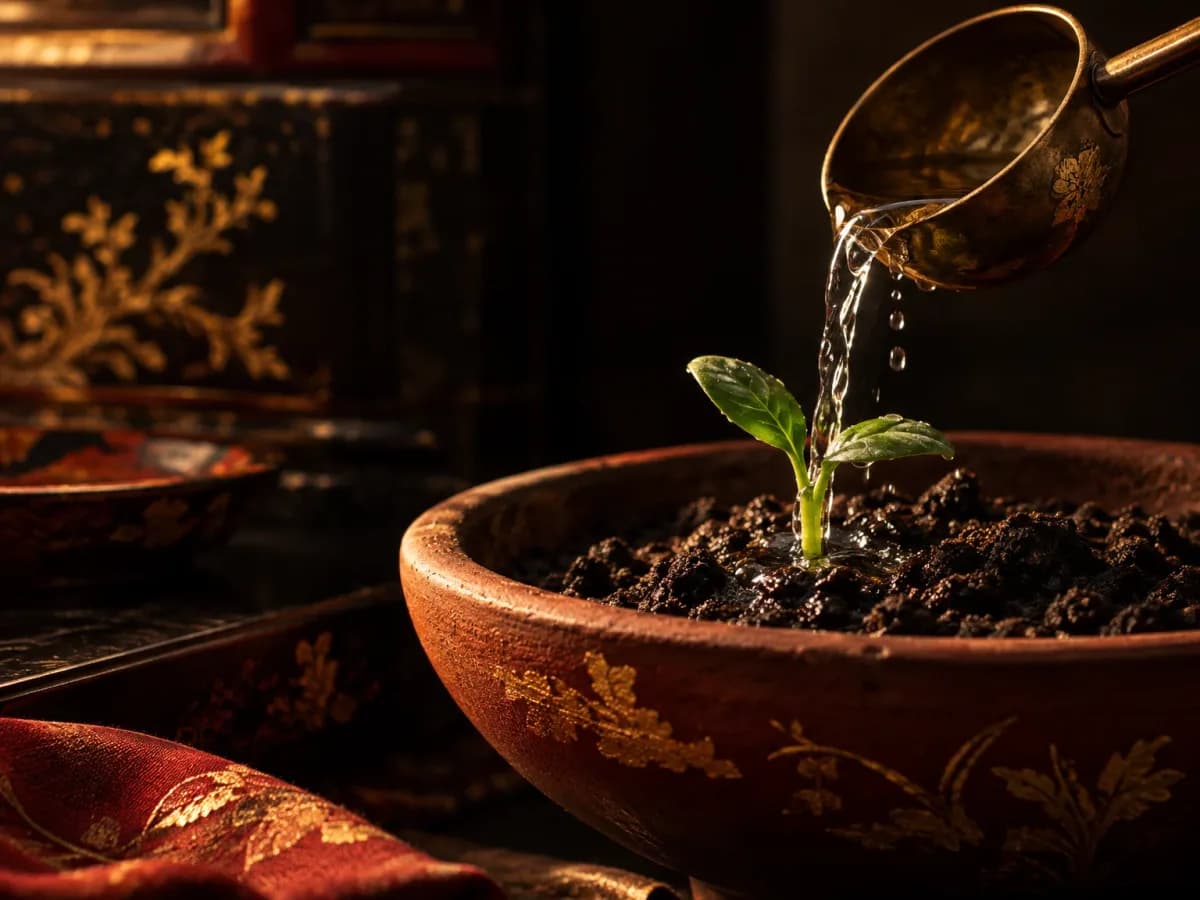
Water nourishing a young green sprout is the clearest visual illustration of Water generating Wood in nature.
Five generative pairs and the two directions of incoming and outgoing generation
The generative cycle begins with Wood generating Fire (dry wood feeds flames), followed by Fire generating Earth (ash enriches soil), Earth generating Metal (soil condenses precious ore), Metal generating Water (melted metal becomes liquid), and closes with Water generating Wood (water nourishes trees). All five elements continuously transmit vitality to one another in an unbroken ring.
Suppose you carry the characteristics of Wood element individuals: the Water element acts as incoming generation that directly replenishes your core energy. Conversely, the Fire element sits in the outgoing generation direction, helping you express talent outwardly, though excessive outgoing generation when your root energy is weak can easily lead to exhaustion.
3. Is Five Elements mutual restriction always unfavorable?
In Eastern philosophy, mutual restriction (tương khắc) is an essential regulatory mechanism that prevents any single element from growing unchecked and disrupting the overall order. Generation and restriction always work in tandem to preserve equilibrium across all living things.
Five restrictive pairs and the principle of constructive restraint
The restrictive cycle consists of Wood restricting Earth (tree roots hold soil in place), Earth restricting Water (embankments contain floodwaters), Water restricting Fire (water extinguishes roaring flames), Fire restricting Metal (fire forges metal tools), and Metal restricting Wood (axes and saws carve timber). This constructive restraint is the exact force that shapes raw potential into practical utility.
| Core Element | Incoming Generation | Outgoing Generation | Incoming Restriction | Outgoing Restriction |
|---|---|---|---|---|
| Metal (Kim) | Earth (Earth generates Metal) | Water (Metal generates Water) | Fire (Fire restricts Metal) | Wood (Metal restricts Wood) |
| Wood (Mộc) | Water (Water generates Wood) | Fire (Wood generates Fire) | Metal (Metal restricts Wood) | Earth (Wood restricts Earth) |
| Water (Thủy) | Metal (Metal generates Water) | Wood (Water generates Wood) | Earth (Earth restricts Water) | Fire (Water restricts Fire) |
| Fire (Hỏa) | Wood (Wood generates Fire) | Earth (Fire generates Earth) | Water (Water restricts Fire) | Metal (Fire restricts Metal) |
| Earth (Thổ) | Fire (Fire generates Earth) | Metal (Earth generates Metal) | Wood (Wood restricts Earth) | Water (Earth restricts Water) |
In the classical compendium San Ming Tong Hui (Tam Mệnh Thông Hội), many Na Yin elements require restriction in order to achieve true usefulness. Specifically, Sword-Edge Metal (Kiếm Phong Kim) needs Fire to be tempered into a sharp blade, and Great Forest Wood (Đại Lâm Mộc) requires Metal to be hewn into sturdy structural pillars.
4. When do reverse generation and reverse restriction occur?
When one element becomes excessively dominant or severely depleted, the normal direction of interaction reverses into reverse generation (phản sinh) and reverse restriction (phản khắc). Grasping this principle helps cultivate moderation and balance in both work and daily habits.
Reverse generation (excessive support becomes harm) and reverse restriction (extremes reverse)
Reverse generation occurs when the nourishing element is so excessive that it overwhelms the recipient: too much Metal makes Water turbid (Kim đa Thủy trọc), torrential Water washes Wood away (Thủy đa Mộc phiêu), and thick wet Wood smothers Fire (Mộc đa Hỏa tức). Similarly, scorching Fire cracks Earth (Hỏa đa Thổ tiêu), and overly thick Earth buries Metal completely (Thổ đa Kim mai).
Reverse restriction takes place when the restricting element is too weak while the restricted element is overwhelmingly strong: a thin blade striking an ancient tree will chip (Mộc kiên Kim khuyết), and a small flame meeting a massive block of metal will die out on its own. Likewise, a few drops of water falling into a blazing furnace evaporate instantly, a thin earthen dike facing a major flood gives way, and rock-hard soil snaps tender young roots.
> Note: The principles of reverse generation and reverse restriction remind us that overprotection can breed dependency, whereas manageable pressure builds resilience. When applying the Five Elements, the highest goal is always dynamic harmony.
5. How are Five Elements generation and restriction applied in Zi Wei Dou Shu and daily life?
Understanding Five Elements theory provides the stepping stone for reading deeper layers of a Zi Wei chart (lá số Tử Vi) in Purple Star Astrology (Tử Vi Đẩu Số) as well as organizing your living environment. Below are three practical applications that anyone can cross-check directly.
Reading the relationship between the natal element and the Five-Element Bureau on a Zi Wei chart
On a Zi Wei chart, alongside your birth-year Na Yin element in the natal chart (bản mệnh), you also have the Five-Element Bureau (Ngũ hành cục) in Zi Wei Dou Shu, which comprises Water 2nd Bureau (Thủy nhị cục), Wood 3rd Bureau (Mộc tam cục), Metal 4th Bureau (Kim tứ cục), Earth 5th Bureau (Thổ ngũ cục), and Fire 6th Bureau (Hỏa lục cục). The natal element represents the individual self, whereas the Bureau represents the surrounding social environment.
When the Bureau generates the natal element or the two share the same element in neutral harmony, the chart holder adapts smoothly to surrounding circumstances. If the natal element generates the Bureau, the individual willingly invests effort into the collective; when the Bureau restricts the natal element, early life requires greater self-reliance to forge resilience.
Examining the Five Elements of the Life Palace and daily coordination
All twelve palace cells on the chart grid carry fixed elements according to their Earthly Branch: Yin (Dần) and Mao (Mão) belong to Wood; Si (Tỵ) and Wu (Ngọ) belong to Fire; Shen (Thân) and You (Dậu) belong to Metal; Hai (Hợi) and Zi (Tý) belong to Water; and Chen (Thìn), Xu (Tuất), Chou (Sửu), and Wei (Mùi) belong to Earth. Readers always compare whether the element of each major star (chính tinh) generates or harmonizes with the element of the Life Palace (cung Mệnh) and the birth-year Na Yin element.
In everyday life, you can apply mutual generation to select an element-compatible color chart by Five Elements for clothing and interiors, or consult it when learning how to compare marital age compatibility. Pairing a creative Wood-oriented person with a disciplined Metal-oriented colleague often builds a well-rounded team.
Key points
- The Five Elements comprise Metal, Wood, Water, Fire, and Earth in continuous natural transformation.
- Mutual generation cycle: Wood -> Fire -> Earth -> Metal -> Water -> Wood nourish one another.
- Mutual restriction cycle: Wood -> Earth -> Water -> Fire -> Metal -> Wood regulate one another.
- The ultimate aim of the Five Elements is balance; both excess and deficiency trigger counterproductive reversals.
Want to see how your Na Yin Five Elements interact with your Five-Element Bureau, Life Palace, and the 14 major stars? You can generate a free personal Zi Wei chart for a detailed breakdown based on your exact birth date and hour.
Frequently asked questions
Can two people whose Five Elements restrict each other work together effectively?
Yes, they can work together very effectively when roles are divided appropriately. A decisive, action-focused partner complements a detail-oriented colleague well, provided both sides respect shared principles and communicate transparently.
Between mutual generation and same-element harmony, which is better?
Each relationship offers distinct strengths depending on the state of the natal chart. Mutual generation supplies replenishing energy from outside, whereas same-element harmony fosters resonance and reinforces internal strength.
When evaluating the Five Elements on a Zi Wei chart, should you prioritize the birth-year element or the Bureau?
Both are read side by side through the natal element and Bureau relationship. The birth-year element reflects core inner disposition, while the Five-Element Bureau determines the starting age of each decade cycle (đại vận) and how smoothly external conditions support you.
How do you reconcile two clashing elements within a family?
The traditional method uses a bridging element (hành thông quan), an intermediate phase that transforms restriction into generation. For instance, when Water and Fire clash, adopting Wood qualities, such as patient listening and gentle communication, bridges the gap because Water generates Wood and Wood generates Fire.
Sources
- Wan Minying (Vạn Dân Anh), San Ming Tong Hui (Tam Mệnh Thông Hội): Section on Five Elements generation, restriction, transformation, and reverse dynamics.
- Xu Lewu (Từ Nhạc Ngô), Zi Ping Zhen Quan (Tử Bình Chân Thuyên): Chapter on Yin-Yang (âm dương) and Five Elements balance across the solar term (tiết khí) seasons.
- Vân Đằng Thái Thứ Lang, Zi Wei Dou Shu Newly Compiled (Tử Vi Đẩu Số Tân Biên): Section comparing generative and restrictive interactions among the Life Palace, Body Palace (cung Thân), Five-Element Bureau, and chart palaces.