The 12 Vietnamese zodiac animals (12 con giáp) form a traditional symbolic cycle representing the twelve Earthly Branch (địa chi) stations in East Asian timekeeping, ordered sequentially as Zi (Tý), Chou (Sửu), Yin (Dần), Mao (Mão), Chen (Thìn), Si (Tỵ), Wu (Ngọ), Wei (Mùi), Shen (Thân), You (Dậu), Xu (Tuất), and Hai (Hợi). This twelve-part framework tracks lunisolar calendar (âm lịch) years, months, and two-hour birth windows.
1. What animals make up the order of the 12 zodiac signs in Vietnamese culture?
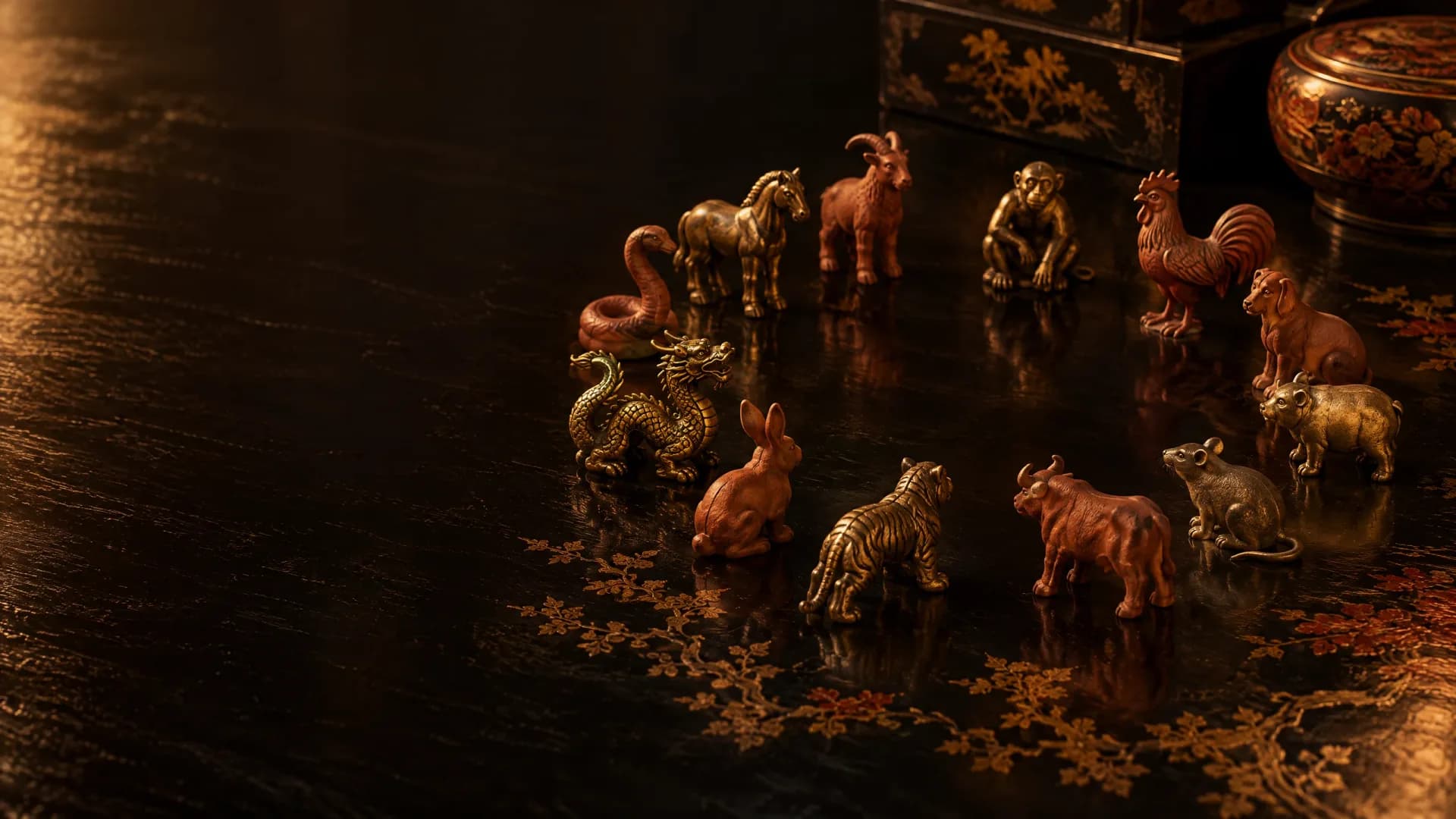
In Vietnamese culture, the twelve zodiac animals follow the fixed twelve-step Earthly Branch sequence: Zi (Rat), Chou (Water Buffalo), Yin (Tiger), Mao (Cat), Chen (Dragon), Si (Snake), Wu (Horse), Wei (Goat), Shen (Monkey), You (Rooster), Xu (Dog), and Hai (Pig). Throughout Vietnam, these twelve symbolic creatures are closely tied to every person's lunisolar birth year and everyday cultural life.
When exploring sexagenary cycle (can chi) and zodiac studies, you will notice that behind this traditional sequence lies a remarkably observant classification of natural biological rhythms recorded by ancient agrarian communities.
How the biological rhythm of the 12 double-hours explains the zodiac order
The twelve zodiac animals are arranged according to the characteristic daily habits and peak activity hours of each creature across the twelve traditional double-hours (where each double-hour spans two modern clock hours):
- Zi (23:00 - 01:00) & Chou (01:00 - 03:00): Rats forage actively at midnight, while water buffaloes chew their cud quietly in preparation for early morning plowing.
- Yin (03:00 - 05:00) & Mao (05:00 - 07:00): Tigers prowl and hunt before daybreak, while cats stretch and step out to greet the morning dawn.
- Chen (07:00 - 09:00) & Si (09:00 - 11:00): Morning mist rises into clouds associated with soaring dragons, while snakes rest calmly in warming grass without disturbing passersby.
- Wu (11:00 - 13:00) & Wei (13:00 - 15:00): Horses gallop across open fields beneath the high midday sun, while goats graze on dewy grass in the gentle early afternoon.
- Shen (15:00 - 17:00) & You (17:00 - 19:00): Monkeys call to their troops as late afternoon shadows lengthen, while roosters and hens return to their coops at dusk.
- Xu (19:00 - 21:00) & Hai (21:00 - 23:00): Dogs stay alert to guard the household courtyard in the evening, while pigs sleep soundly in the quiet of night.
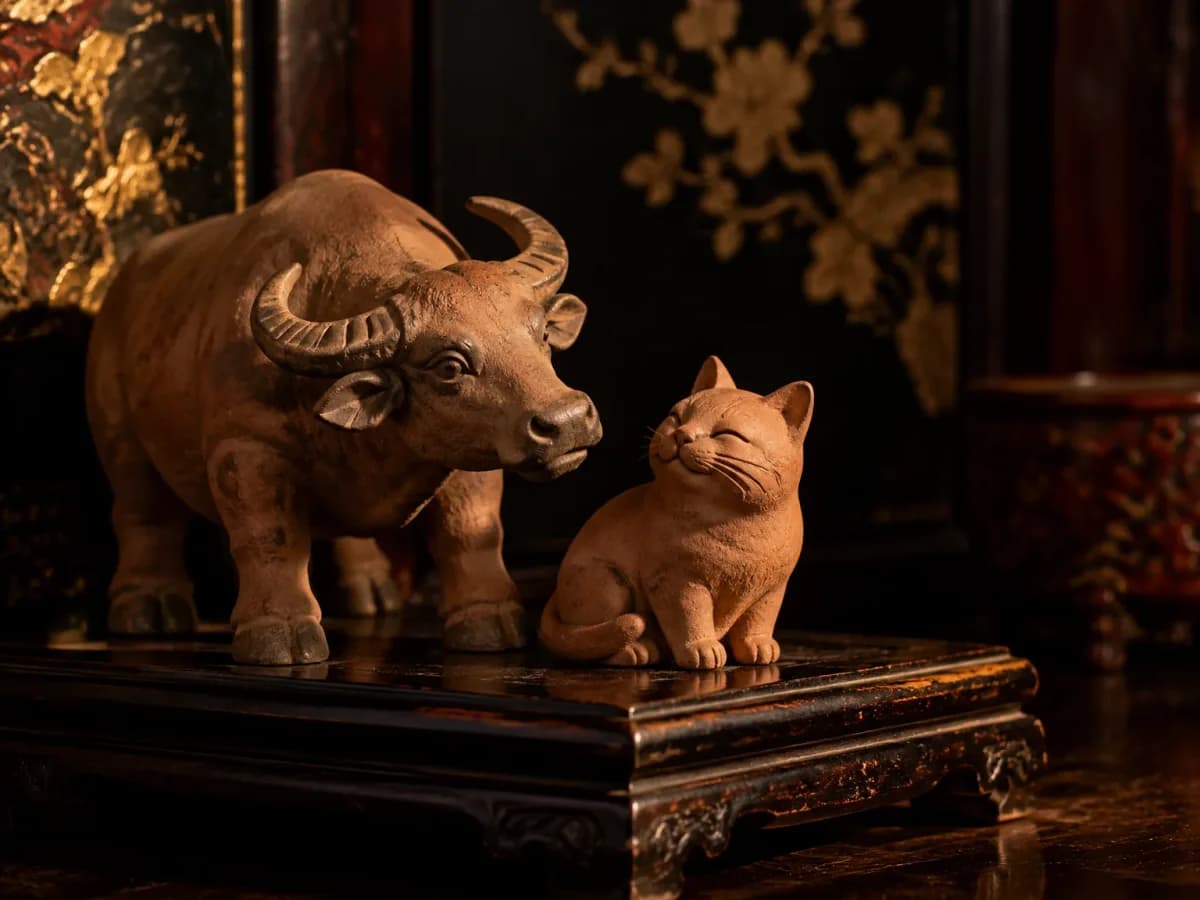
The imagery of the Water Buffalo (Chou) and the Cat (Mao) reflects the wet-rice agricultural heritage of Vietnam's Red River Delta.
Why is the fourth Vietnamese zodiac animal the Cat (Mao) instead of the Rabbit?
A distinctive hallmark of Vietnamese culture is that the fourth Earthly Branch position, Mao (Mão), is represented by the Cat rather than the Rabbit found in neighboring northern traditions. Beyond the close phonetic similarity between the Sino-Vietnamese reading "Mao" and the Vietnamese word for cat ("meo"), this choice grew directly out of Vietnam's wet-rice farming economy.
To protect household granaries and rice stores from destructive field rats (the animal of the first branch, Zi), the domestic cat became an indispensable companion under every Vietnamese roof. At the same time, the northern ox was localized into the familiar water buffalo for Chou (Sửu), the loyal draft animal of flooded rice paddies.
2. How do you look up the 12 zodiac animals by birth year from 1960 to 2031?
You can look up your zodiac sign by matching your lunisolar birth year to the twelve-year repeating Earthly Branch cycle from 1960 through 2031. Because each zodiac animal repeats every twelve years and pairs sequentially with the five Heavenly Stem (thiên can) couples to complete the sixty-year sexagenary cycle, the reference table below lets you verify your exact birth-year branch and intrinsic Five Elements (ngũ hành) phase at a glance.
| No. | Branch | Zodiac Animal | Intrinsic Element | Corresponding Lunar Birth Years (1960 - 2031) |
|---|---|---|---|---|
| 1 | Zi (Tý) | Rat (Chuột) | Water | 1960, 1972, 1984, 1996, 2008, 2020 |
| 2 | Chou (Sửu) | Water Buffalo (Trâu) | Earth | 1961, 1973, 1985, 1997, 2009, 2021 |
| 3 | Yin (Dần) | Tiger (Hổ) | Wood | 1962, 1974, 1986, 1998, 2010, 2022 |
| 4 | Mao (Mão) | Cat (Mèo) | Wood | 1963, 1975, 1987, 1999, 2011, 2023 |
| 5 | Chen (Thìn) | Dragon (Rồng) | Earth | 1964, 1976, 1988, 2000, 2012, 2024 |
| 6 | Si (Tỵ) | Snake (Rắn) | Fire | 1965, 1977, 1989, 2001, 2013, 2025 |
| 7 | Wu (Ngọ) | Horse (Ngựa) | Fire | 1966, 1978, 1990, 2002, 2014, 2026 |
| 8 | Wei (Mùi) | Goat (Dê) | Earth | 1967, 1979, 1991, 2003, 2015, 2027 |
| 9 | Shen (Thân) | Monkey (Khỉ) | Metal | 1968, 1980, 1992, 2004, 2016, 2028 |
| 10 | You (Dậu) | Rooster (Gà) | Metal | 1969, 1981, 1993, 2005, 2017, 2029 |
| 11 | Xu (Tuất) | Dog (Chó) | Earth | 1970, 1982, 1994, 2006, 2018, 2030 |
| 12 | Hai (Hợi) | Pig (Lợn) | Water | 1971, 1983, 1995, 2007, 2019, 2031 |
Important note when converting early Gregorian birth dates into a zodiac sign
In Vietnamese tradition, a person's zodiac animal is determined strictly by the lunisolar year, which begins on the first day of the Lunar New Year (Tết Nguyên Đán). For example, the Ding Wei Lunar New Year of 2027 falls on February 6, 2027 on the Gregorian calendar; therefore, a baby born on January 25, 2027 on the Gregorian calendar still belongs to the Year of the Horse (Bing Wu 2026) and has not yet entered the Ding Wei Goat year.
3. Which temperament groups classify the 12 zodiac animals?
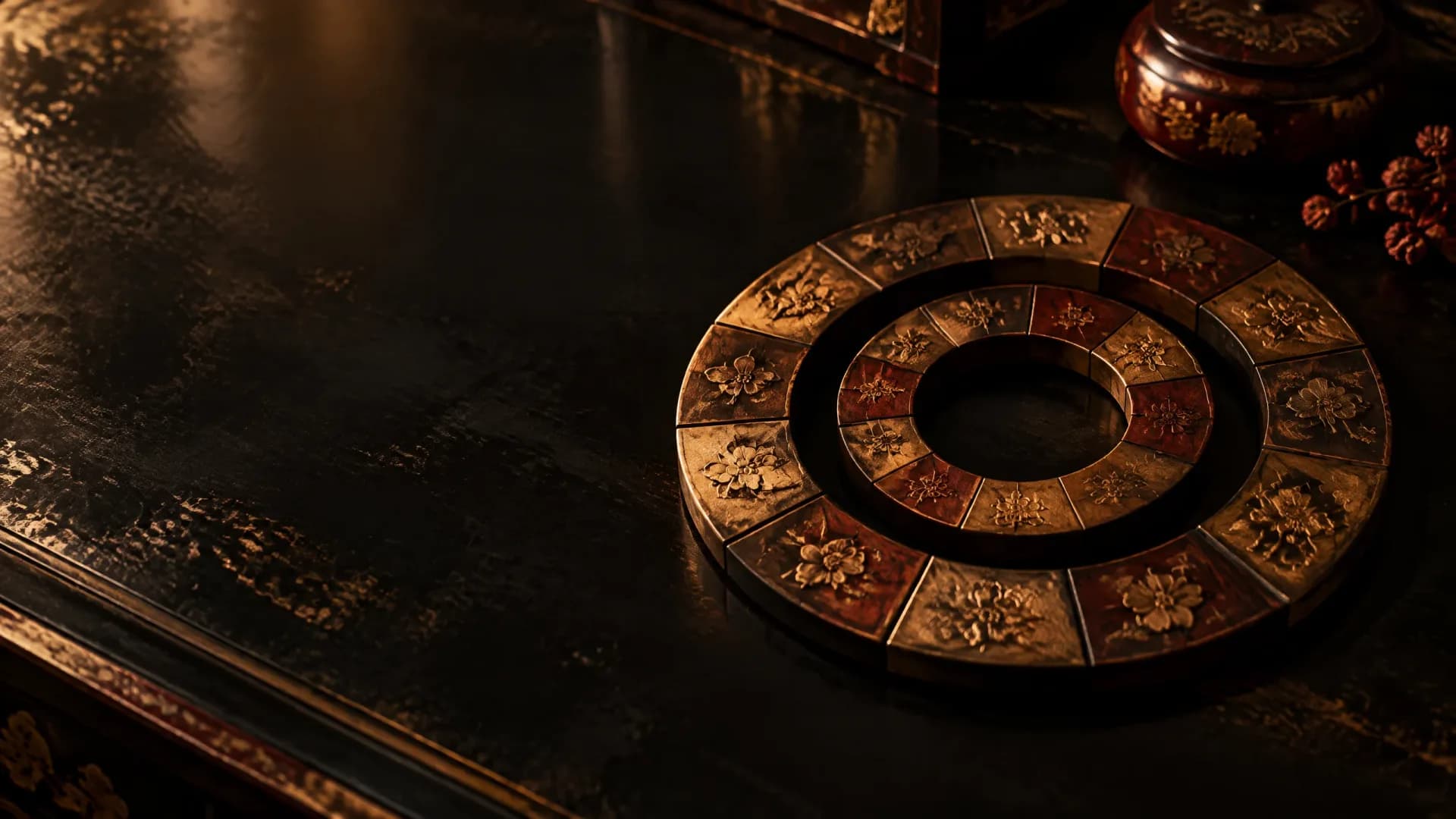
On a Zi Wei chart (lá số Tử Vi), classical scholars divide the twelve Earthly Branches on the twelve-palace grid into three positional temperament groups: the Four Growth Positions (Tứ Sinh: Yin, Shen, Si, Hai), the Four Cardinal Positions (Tứ Chính: Zi, Wu, Mao, You), and the Four Storage Positions (Tứ Mộ: Chen, Xu, Chou, Wei). Each four-branch group occupies a distinct geometric role on the chart wheel and reflects a characteristic approach to action.
The three groups: Four Growth Positions, Four Cardinal Positions, and Four Storage Positions
The Four Growth Positions (Yin, Shen, Si, Hai) sit at the four diagonal corners of the Zi Wei chart, the exact cells where the traveling star Tian Ma (Thiên Mã) resides, corresponding to the opening month of each of the four seasons. Individuals born in the years of the Tiger, Monkey, Snake, and Pig typically adapt quickly to changing circumstances, enjoy hands-on movement, and thrive in trade, logistics, and external relations.
The Four Cardinal Positions (Zi, Wu, Mao, You) occupy the four cardinal directions of North, South, East, and West at the peak of each season. People born under the Rat, Horse, Cat, and Rooster often display clear-cut personal preferences and focused concentration, whereas those in the Four Storage Positions (Chen, Xu, Chou, Wei), governed by the Earth element at the close of each season, stand out for their steady composure, trustworthiness, and talent for long-term resource accumulation.
4. How do the Three Harmonies, Six Harmonies, and Six Clashes rules work among the 12 zodiac animals?
When the twelve zodiac animals are placed around a 360-degree circular clock dial spaced at 30-degree intervals, their harmonious and clashing relationships form balanced geometric angles governed by the rules of Three Harmonies and Four Clashes. To understand how stem-branch pairings and natal elements interact in full, you should read this table alongside our guide to what Heavenly Stems and Earthly Branches are and the birth-year and Na Yin element lookup table.
| Zodiac Branch | Three Harmonies Group (120 Degrees Apart) | Six Harmonies Pair | Six Clashes Pair (180 Degrees) | Four Clashes Group |
|---|---|---|---|---|
| Zi (Rat) | Shen, Zi, Chen (Water bureau) | Zi and Chou | Zi and Wu | Zi, Wu, Mao, You |
| Chou (Buffalo) | Si, You, Chou (Metal bureau) | Chou and Zi | Chou and Wei | Chen, Xu, Chou, Wei |
| Yin (Tiger) | Yin, Wu, Xu (Fire bureau) | Yin and Hai | Yin and Shen | Yin, Shen, Si, Hai |
| Mao (Cat) | Hai, Mao, Wei (Wood bureau) | Mao and Xu | Mao and You | Zi, Wu, Mao, You |
| Chen (Dragon) | Shen, Zi, Chen (Water bureau) | Chen and You | Chen and Xu | Chen, Xu, Chou, Wei |
| Si (Snake) | Si, You, Chou (Metal bureau) | Si and Shen | Si and Hai | Yin, Shen, Si, Hai |
| Wu (Horse) | Yin, Wu, Xu (Fire bureau) | Wu and Wei | Wu and Zi | Zi, Wu, Mao, You |
| Wei (Goat) | Hai, Mao, Wei (Wood bureau) | Wei and Wu | Wei and Chou | Chen, Xu, Chou, Wei |
| Shen (Monkey) | Shen, Zi, Chen (Water bureau) | Shen and Si | Shen and Yin | Yin, Shen, Si, Hai |
| You (Rooster) | Si, You, Chou (Metal bureau) | You and Chen | You and Mao | Zi, Wu, Mao, You |
| Xu (Dog) | Yin, Wu, Xu (Fire bureau) | Xu and Mao | Xu and Chen | Chen, Xu, Chou, Wei |
| Hai (Pig) | Hai, Mao, Wei (Wood bureau) | Hai and Yin | Hai and Si | Yin, Shen, Si, Hai |
Distinguishing between the Four Clash groups and direct Six Clashes pairs
Within any Four Clashes quartet, only the two zodiac signs sitting directly opposite each other at 180 degrees form a direct Six Clashes (Lục xung) pair: namely the six pairs Zi and Wu, Chou and Wei, Yin and Shen, Mao and You, Chen and Xu, and Si and Hai. By contrast, two signs positioned at a 90-degree right angle within the same quartet (such as Yin and Hai, which actually form a mutually supportive Six Harmonies (Lục hợp) pair) do not clash severely at all. Keeping this distinction clear helps you make balanced assessments when reviewing how to choose a compatible business partner age or checking how to calculate Three Calamities years alongside the Three Harmonies (Tam hợp).
> Note: The birth-year zodiac animal represents only one of the four time pillars (Year, Month, Day, and Hour). Two people whose birth years fall into a Six Clashes pair can still build a thriving family or business partnership when their birth months, days, and hours balance each other and both practice attentive communication.
5. Why do two people with the same birth-year zodiac animal lead different lives?
Two people born in the same lunar year lead different lives because Purple Star Astrology (Tử Vi Đẩu Số) determines individual personality and life cycles through the crucial roles of birth month, birth day, and birth hour. Although millions of individuals born in the same lunar year share one zodiac animal and one Na Yin Five Elements (Ngũ hành nạp âm) natal chart (bản mệnh) identity, their full twelve-palace charts diverge into thousands of distinct structures.
Birth month and birth hour determine the positions of the Life Palace and Body Palace
On a Zi Wei chart, locating which of the twelve cells holds the Life Palace (cung Mệnh) and the Body Palace (cung Thân) requires counting forward from the Yin cell by the lunar birth month and then counting by the Earthly Branch of the birth hour. Because each day contains twelve double-hours and each year contains twelve lunar months, people who share the same birth-year zodiac animal are distributed across 144 different Life Palace and Body Palace combinations, and adding the lunar birth day to place Zi Wei (Tử Vi) and the other major star (chính tinh) placements produces thousands of unique individual charts.
Key points
- The 12 zodiac animals follow the fixed Earthly Branch order: Zi, Chou, Yin, Mao, Chen, Si, Wu, Wei, Shen, You, Xu, and Hai.
- Vietnamese tradition honors the Cat (Mao) and the Water Buffalo (Chou), reflecting wet-rice agricultural life.
- The 4 Three Harmonies triads are Shen, Zi, and Chen; Yin, Wu, and Xu; Hai, Mao, and Wei; and Si, You, and Chou.
- People sharing the same birth-year zodiac animal have different Zi Wei charts depending on their birth month, day, and hour.
Want to see how your lunar birth month, day, and birth hour combine with your birth-year zodiac sign to shape your Life Palace, Wealth Palace (cung Tài Bạch), and Career Palace (cung Quan Lộc)? You can generate a free personal Zi Wei chart to read your individualized interpretation.
Frequently asked questions
If someone is born at 23:15 at night, does that count as the next lunar day or the same day?
In traditional East Asian calendrical science and Zi Wei Dou Shu, a new lunar day begins at the start of the Zi hour, which is 23:00 at night. Therefore, a birth at 23:15 on the 5th day of the lunar month is customarily calculated under the early Zi hour of the 6th lunar day.
Which zodiac animal and Na Yin element govern the year 2027?
The lunar year 2027 is the Ding Wei year, represented by the Goat (the Wei Earthly Branch paired with the Ding Heavenly Stem) and governed by the Na Yin element Heavenly River Water (Thiên Hà Thủy), which represents nourishing rainwater falling from the sky.
Within the Yin, Shen, Si, and Hai group, are Tiger (Yin) and Pig (Hai) clashing or harmonious?
Tiger (Yin) and Pig (Hai) actually form a Six Harmonies pair (Yin and Hai combine into Wood) that supports each other very well; within the Four Growth Positions group, only the two directly opposing diagonal pairs clash: Yin clashes with Shen, and Si clashes with Hai.
What should you do for a Zi Wei reading if you do not remember the exact zodiac hour of birth?
If you only recall an approximate birth time near the boundary between two adjacent double-hours, you should generate charts for both neighboring hours and compare the personality descriptions of the Life Palace as well as past milestone events to identify which chart matches your life accurately.
Sources
- Wang Chong (Eastern Han Dynasty), Lun Heng (Discourses Weighed in the Balance): Early historical record documenting the twelve Earthly Branches paired with the twelve symbolic animals.
- Wan Minying, San Ming Tong Hui (Compendium of the Three Fates): Classical treatises on the twelve Earthly Branches, Three Harmonies, Six Harmonies, Six Clashes, and the twelve daily double-hours.
- Vân Đằng Thái Thứ Lang, New Compendium of Zi Wei Dou Shu: Rules for anchoring the Life Palace and Body Palace from the lunar birth month and birth hour across the twelve Earthly Branch cells.