What are Heavenly Stems and Earthly Branches? The Heavenly Stems (thiên can) and Earthly Branches (địa chi), abbreviated as the sexagenary cycle (can chi), form the classical East Asian coordinate system marking cycles of time and space, combining ten Heavenly Stems with twelve Earthly Branches. Pairing stems and branches of matching Yin-Yang (âm dương) polarity creates the sixty-year Sixty Jiazi Cycle (Lục Thập Hoa Giáp).
1. What are the 10 Heavenly Stems and what meanings do they carry?
The ten Heavenly Stems are a fixed cyclical sequence of ten celestial symbols: Jia (Giáp), Yi (Ất), Bing (Bính), Ding (Đinh), Wu (Mậu), Ji (Kỷ), Geng (Canh), Xin (Tân), Ren (Nhâm), and Gui (Quý), representing the movement of heavenly energy across the earth. In classical Eastern philosophy, "Heavenly Stems" are envisioned like a tree trunk reaching toward the sky, tracking how atmospheric energy nurtures life below.
When exploring the sexagenary cycle and zodiac signs, you will notice that each Heavenly Stem describes a stage in the annual growth cycle of plant life across the four seasons. This progression moves from a seed cracking its shell at Jia (Giáp), sprouting at Yi (Ất), shining in vigor at Bing (Bính), growing sturdy at Ding (Đinh), flourishing at Wu (Mậu), taking form at Ji (Kỷ), bearing fruit at Geng (Canh), ripening into new seed at Xin (Tân), storing vitality at Ren (Nhâm), and resting in reserve for the next cycle at Gui (Quý).
| No. | Heavenly Stem | Yin-Yang | Element | Direction | Five Combinations (Ngũ Hợp) | Stem Clash |
|---|---|---|---|---|---|---|
| 1 | Jia (Giáp) | Yang | Wood | East | Jia and Ji transform into Earth | Jia and Geng |
| 2 | Yi (Ất) | Yin | Wood | East | Yi and Geng transform into Metal | Yi and Xin |
| 3 | Bing (Bính) | Yang | Fire | South | Bing and Xin transform into Water | Bing and Ren |
| 4 | Ding (Đinh) | Yin | Fire | South | Ding and Ren transform into Wood | Ding and Gui |
| 5 | Wu (Mậu) | Yang | Earth | Center | Wu and Gui transform into Fire | Central axis |
| 6 | Ji (Kỷ) | Yin | Earth | Center | Ji and Jia transform into Earth | Central axis |
| 7 | Geng (Canh) | Yang | Metal | West | Geng and Yi transform into Metal | Geng and Jia |
| 8 | Xin (Tân) | Yin | Metal | West | Xin and Bing transform into Water | Xin and Yi |
| 9 | Ren (Nhâm) | Yang | Water | North | Ren and Ding transform into Wood | Ren and Bing |
| 10 | Gui (Quý) | Yin | Water | North | Gui and Wu transform into Fire | Gui and Ding |
Rules governing Yin-Yang polarity, Five Elements, Harmony, and Clash among Heavenly Stems
The ten Heavenly Stems divide into five pairs following the generative order of the Five Elements (ngũ hành): Wood, Fire, Earth, Metal, and Water. Every stem in an odd position carries Yang polarity; every stem in an even position carries Yin polarity.
Two Heavenly Stems spaced five positions apart combine to form the Five Combinations (Ngũ Hợp), also called Heavenly Stem Harmony (Thiên can hợp): Jia-Ji, Yi-Geng, Bing-Xin, Ding-Ren, and Wu-Gui. Conversely, two Heavenly Stems of matching Yin or Yang polarity spaced six positions apart that control each other elementally form a Heavenly Stem Clash (Thiên can xung) relationship.
2. How do the 12 Earthly Branches correspond to months, hours, and compass directions?
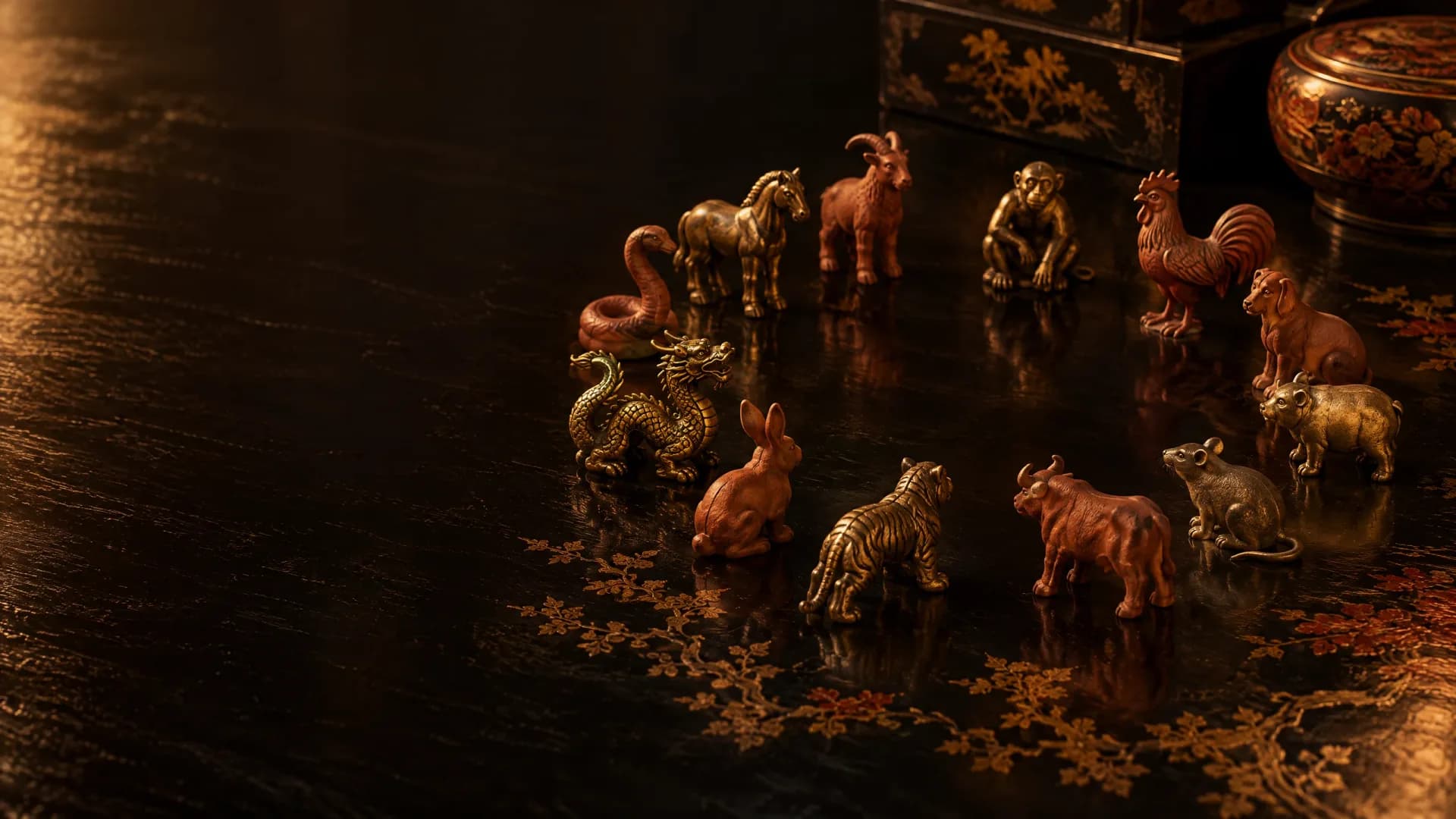
The twelve Earthly Branches map out the twelve solar-term months of the year, the twelve two-hour periods of the day, and the twelve compass directions in the fixed order Zi (Tý), Chou (Sửu), Yin (Dần), Mao (Mão), Chen (Thìn), Si (Tỵ), Wu (Ngọ), Wei (Mùi), Shen (Thân), You (Dậu), Xu (Tuất), and Hai (Hợi). Classical scholars linked the twelve Earthly Branches with the traditional order of the 12 zodiac animals, yet at their core the Earthly Branches are space-time coordinates.
| Earthly Branch | Zodiac Animal | Yin-Yang | Element | Lunar Month | Two-Hour Period | Direction |
|---|---|---|---|---|---|---|
| Zi (Tý) | Rat | Yang | Water | 11th Month | 23:00 - 01:00 | North |
| Chou (Sửu) | Ox | Yin | Earth | 12th Month | 01:00 - 03:00 | Northeast |
| Yin (Dần) | Tiger | Yang | Wood | 1st Month | 03:00 - 05:00 | Northeast |
| Mao (Mão) | Cat / Rabbit | Yin | Wood | 2nd Month | 05:00 - 07:00 | East |
| Chen (Thìn) | Dragon | Yang | Earth | 3rd Month | 07:00 - 09:00 | Southeast |
| Si (Tỵ) | Snake | Yin | Fire | 4th Month | 09:00 - 11:00 | Southeast |
| Wu (Ngọ) | Horse | Yang | Fire | 5th Month | 11:00 - 13:00 | South |
| Wei (Mùi) | Goat | Yin | Earth | 6th Month | 13:00 - 15:00 | Southwest |
| Shen (Thân) | Monkey | Yang | Metal | 7th Month | 15:00 - 17:00 | Southwest |
| You (Dậu) | Rooster | Yin | Metal | 8th Month | 17:00 - 19:00 | West |
| Xu (Tuất) | Dog | Yang | Earth | 9th Month | 19:00 - 21:00 | Northwest |
| Hai (Hợi) | Pig | Yin | Water | 10th Month | 21:00 - 23:00 | Northwest |
Why is the first lunar month designated as the Yin month rather than the Zi month?
The Zi (Tý) month (the 11th month of the lunisolar calendar (âm lịch)) contains the Winter Solstice (Đông Chí), the point with the longest night of the year, when the first spark of Yang energy stirs underground. Through the Chou (Sửu) month (the 12th lunar month), the soil stays cold; only in the Yin (Dần) month (the 1st lunar month, initiated by the Start of Spring (Lập Xuân) solar term (tiết khí)) does warmth return so plants bud, which is why the Tiger-Established Calendar (lịch Kiến Dần) sets Yin as the first agricultural month.
3. Why does pairing 10 Heavenly Stems with 12 Earthly Branches produce exactly 60 Jiazi pairs?
Pairing 10 Heavenly Stems with 12 Earthly Branches yields 60 combinations instead of 120 because an unbreakable rule requires Yang Stems to pair only with Yang Branches and Yin Stems to pair only with Yin Branches. Combinatorially, freely matching 10 items with 12 items would create 120 pairs, yet the Sixty Jiazi Cycle (Lục Thập Hoa Giáp) contains exactly 60 stem-branch pairs before repeating.

The ten Heavenly Stems and twelve Earthly Branches mesh like two interlocking gears governed by matching Yin-Yang polarity to form the sixty-year cycle.
The two-gear mechanism and the origin of Decade Void (Tuần Không)
Picture a 10-tooth gear (Heavenly Stems) meshing with a 12-tooth gear (Earthly Branches): tooth 1, Jia (Giáp), engages tooth 1, Zi (Tý), to form Jia Zi (Giáp Tý); tooth 2, Yi (Ất), engages tooth 2, Chou (Sửu), to form Yi Chou (Ất Sửu). By the 10th step at Gui You (Quý Dậu), the Heavenly Stem gear completes one full rotation while the Earthly Branch gear has two unmeshed teeth left: Xu (Tuất) and Hai (Hợi).
In the second round, Jia pairs with Xu to form Jia Xu (Giáp Tuất). Because the least common multiple of 10 and 12 is 60, the 10-tooth gear rotates 6 times and the 12-tooth gear rotates 5 times before Jia meets Zi again. The two unpaired branches in each ten-year round originate the Decade Void (Tuần Trung Không Vong) star on a Zi Wei chart (lá số Tử Vi), while each paired stem and branch generates a rhythmic element in what Na Yin Five Elements (Ngũ hành nạp âm) are and the 30 Na Yin table.
4. How can you quickly calculate the Heavenly Stem and Earthly Branch of any solar year?
With a simple modulo division formula, you can mentally determine the exact Heavenly Stem and Earthly Branch of any Gregorian solar year in two quick steps.
Step 1: Identify the Heavenly Stem from the last digit of the solar year
Every final digit of a Gregorian solar year maps permanently to one Heavenly Stem (using (year - 4) mod 10, where 0 is Jia through 9 for Gui):
- Ends in 4: Jia (Giáp) | 5: Yi (Ất) | 6: Bing (Bính) | 7: Ding (Đinh) | 8: Wu (Mậu)
- Ends in 9: Ji (Kỷ) | 0: Geng (Canh) | 1: Xin (Tân) | 2: Ren (Nhâm) | 3: Gui (Quý)
Step 2: Identify the Earthly Branch by dividing (year - 4) by 12
Take the Gregorian solar year minus 4, then divide by 12 and find the remainder from 0 to 11:
- Remainder 0: Zi (Tý) | 1: Chou (Sửu) | 2: Yin (Dần) | 3: Mao (Mão) | 4: Chen (Thìn) | 5: Si (Tỵ)
- Remainder 6: Wu (Ngọ) | 7: Wei (Mùi) | 8: Shen (Thân) | 9: You (Dậu) | 10: Xu (Tuất) | 11: Hai (Hợi)
For example, with the year 2027: the last digit is 7, so its Heavenly Stem is Ding (Đinh). Calculating 2027 - 4 = 2023 and dividing by 12 gives 168 with remainder 7, corresponding to Wei (Mùi); thus 2027 is the Ding Wei (Đinh Mùi) year.
> Note: This calculation applies from the 1st day of Lunar New Year through the twelfth lunar month of that year. If someone is born in January or early February on the Gregorian calendar before Lunar New Year's Day, use (solar year - 1) to find their birth-year stem and branch.
5. What role do Heavenly Stems and Earthly Branches play on a Zi Wei Dou Shu chart?
Every step of constructing a chart in Purple Star Astrology (Tử Vi Đẩu Số), including placing the 12 palaces, determining the Five-Element Bureau (Ngũ hành cục), and distributing over a hundred stars, operates on the stem-branch coordinates of the birth year, month, day, and hour.
How Heavenly Stems and Earthly Branches govern star placement
The Heavenly Stem of the birth year (and the annual transit (lưu niên) year) directly determines the positions of Lu Cun (Lộc Tồn), Qing Yang (Kình Dương) and Tuo Luo (Đà La), and Tian Kui (Thiên Khôi) and Tian Yue (Thiên Việt). Simultaneously, the Heavenly Stem activates the Four Transformations (Tứ Hóa): Hua Lu (Hóa Lộc), Hua Quan (Hóa Quyền), Hua Ke (Hóa Khoa), and Hua Ji (Hóa Kỵ), as detailed in annual Four Transformations and the Ding Wei year Four Transformations and birth year and Na Yin Five Elements table.
Meanwhile, the twelve palace cells on the chart carry fixed Earthly Branch names from Zi to Hai. The birth month and hour branches position the Life Palace (cung Mệnh) and Body Palace (cung Thân); the birth-year branch starts the Grand Duke (Thái Tuế) ring on a chart, the Twelve Life Stages (vòng Tràng Sinh), and the alignments in Three Harmonies (Tam hợp) and Four Clash Groups rules.
Key points
- The sexagenary system consists of 10 Heavenly Stems (Jia to Gui) and 12 Earthly Branches (Zi to Hai).
- Yang Stems pair only with Yang Branches, and Yin Stems pair with Yin Branches to form 60 Jiazi pairs.
- Calculate any solar year's stem and branch quickly using
(year - 4) mod 10and(year - 4) mod 12. - In Zi Wei Dou Shu, Heavenly Stems place the Four Transformations and Lu Cun, while Earthly Branches position the 12 palaces.
Want to see how the Heavenly Stems and Earthly Branches of your birth year, month, day, and hour convert and place stars across the 12 palaces? You can generate your free personal Zi Wei chart for an automatic, precise calculation.
Frequently asked questions
Why do the Wu and Ji Heavenly Stems have no direct directional clash pair?
On the directional map of the Five Elements, Jia and Yi in the East face Geng and Xin in the West, while Bing and Ding in the South face Ren and Gui in the North. Because Wu and Ji belong to Earth at the center, they have no opposing direction.
How are the Heavenly Stems of lunar months and two-hour periods calculated?
The Earthly Branches of the 12 lunar months (starting at Yin) and 12 two-hour periods (starting at Zi) are fixed, while their accompanying Heavenly Stems are calculated using the "Five Tigers Formula" (Ngũ Hổ Độn, finding month stems from the year stem) and "Five Rats Formula" (Ngũ Thử Độn, finding hour stems from the day stem).
What does a harmonious Heavenly Stem pair (such as Jia combining with Ji) mean in compatibility reading?
When two people's birth-year Heavenly Stems belong to one of the Five Combinations (Jia-Ji, Yi-Geng, Bing-Xin, Ding-Ren, Wu-Gui), their outward perspectives easily find common ground when discussing long-term plans.
How many years does it take for the exact same Heavenly Stem and Earthly Branch year to repeat?
The repetition cycle of a stem-branch year is exactly 60 years (one full Jiazi cycle). For example, 1967 was a Ding Wei year, and adding 60 years brings the next Ding Wei year in 2027.
Sources
- Sima Qian (Tư Mã Thiên), Records of the Grand Historian (Shiji, Sử Ký, Treatise on the Calendar and Treatise on Pitch Pipes): Classical explanations of the origins of the 10 Heavenly Stems and 12 Earthly Branches in ancient calendar science.
- Wan Minying (Vạn Dân Anh), San Ming Tong Hui (Compendium of the Three Fates, Tam Mệnh Thông Hội): Rules governing stem-branch combinations, the Five Combinations, the Five Tigers Formula, and the Five Rats Formula.
- Vân Đằng Thái Thứ Lang, Revised Zi Wei Dou Shu Compendium (Tử Vi Đẩu Số Tân Biên): Methods for placing stars according to birth-year Heavenly Stems and Earthly Branches across the 12-palace grid.