What is a Zi Wei chart used for?
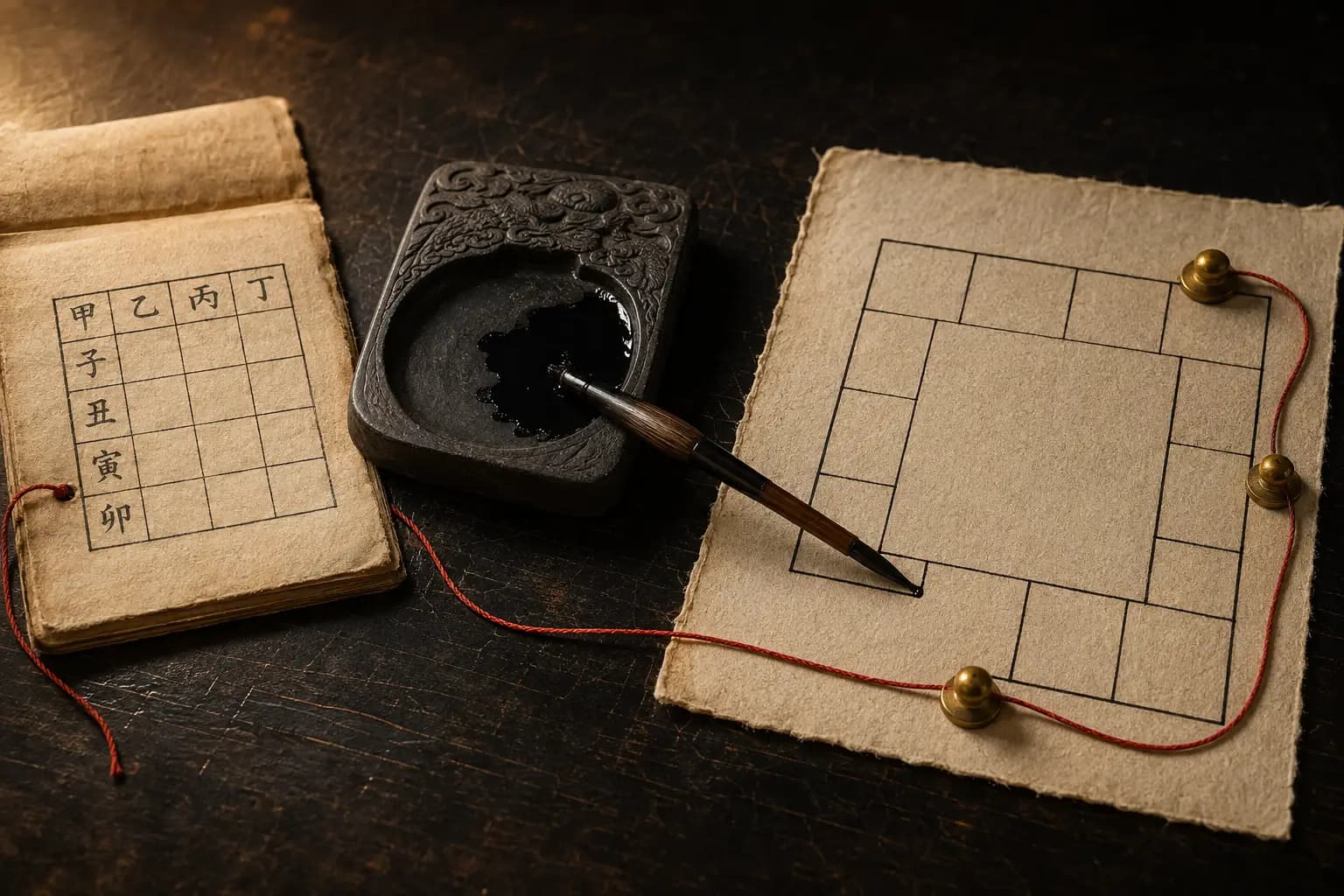
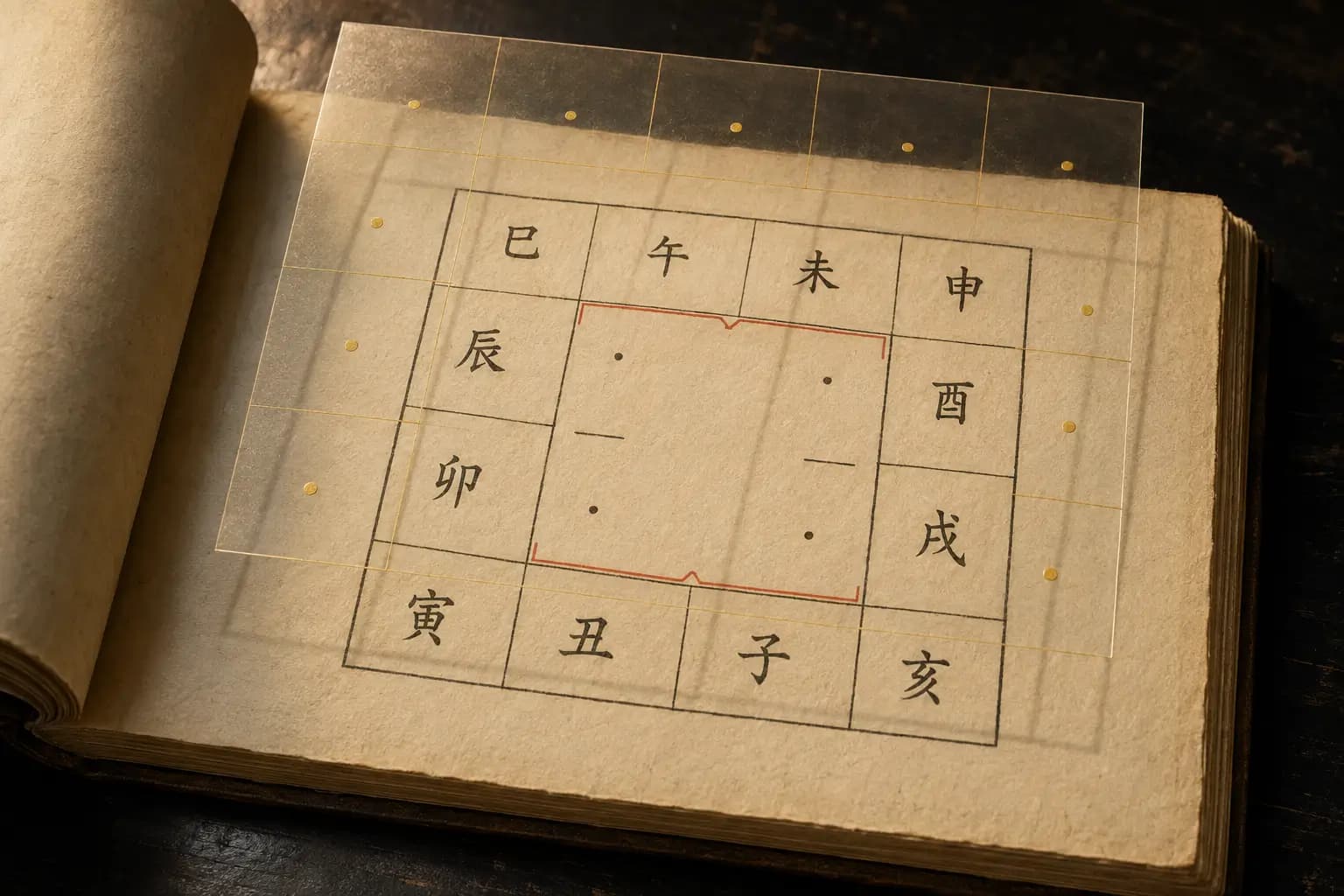
Purple Star Astrology (Tử Vi Đẩu Số) — centered on the pole star Zi Wei (Tử Vi) — is a classical East Asian natal discipline associated with the Song-era compendium attributed to Chen Tuan and transmitted in Vietnam through foundational works such as Vân Đằng Thái Thứ Lang's 1956 synthesis. Laid out on a square grid of twelve Earthly Branch cells surrounding a central Heaven Plate, a Zi Wei chart translates a person's birth moment into a structured reference map.
Readers turn to a natal chart to organize practical questions about themselves: whether their natural working rhythm favors steady institutional stewardship, analytical planning, or rapid front-line execution; how they respond to pressure in shared finances or family responsibilities; and which themes tend to surface during each ten-year decade cycle. By separating structural temperament from timing layers, the chart keeps long-term self-understanding distinct from short-term situational stress.
Most importantly, a natal chart is a map rather than the territory itself. It supplies vocabulary and structured hypotheses so you can weigh career shifts, study plans, or household transitions with clearer self-awareness, while every real-world choice remains firmly in your own hands.
| Chart component | Where it appears | Role during interpretation |
|---|---|---|
| Heaven Plate (central panel) | Center of the twelve-cell grid | Records lunisolar date, sexagenary cycle, Na Yin Five Elements, and Five-Element Bureau |
| Twelve Earthly Branch cells | Outer ring from Zi (Rat) to Hai (Pig) | Divides human experience into twelve interconnected functional palaces |
| Fourteen major stars | Top row of each palace cell | Sets the primary temperament and structural pattern of each palace |
| Auxiliary stars & Four Transformations | Supporting columns inside each cell | Adds catalytic support, friction, and directional shifts (Hua Lu, Hua Quan, Hua Ke, Hua Ji) |
| Decade & annual markers | Age ranges and branch labels per cell | Tracks which palace is activated during each decade cycle and annual transit |
What are the twelve palaces on the chart?
Around the outer perimeter sit twelve fixed Earthly Branch positions running clockwise from Zi, Chou, Yin, and Mao through Xu and Hai. Once the Life Palace is anchored from the lunisolar birth month and birth hour, the remaining eleven palaces are placed in an invariant sequence: Life Palace, Parents Palace, Fortune Palace, Property Palace, Career Palace, Friends Palace, Travel Palace, Health Palace, Wealth Palace, Children Palace, Spouse Palace, and Siblings Palace.
Each palace addresses a distinct domain while remaining linked to the whole grid. The Life Palace reflects core disposition and decision habits; the Career Palace examines work environment and vocational style; the Wealth Palace observes how resources are earned and managed; the Fortune Palace reflects inner resilience and family heritage; and the Travel Palace shows how a person adapts in broader public settings.
Alongside those twelve sits the Body Palace, which never occupies a thirteenth cell of its own. Instead, it co-resides inside one of six key palaces — Life, Fortune, Career, Travel, Wealth, or Spouse — highlighting the life arena where a person invests increasing deliberate effort through adulthood. You can explore every domain in detail on our 12 palaces in a Zi Wei chart guide.
How are stars grouped on a Zi Wei chart?
The structural backbone consists of fourteen major stars divided into two constellations: the northern Zi Wei group (Zi Wei, Tian Ji, Tai Yang, Wu Qu, Tian Tong, Lian Zhen) and the southern Tian Fu group (Tian Fu, Tai Yin, Tan Lang, Ju Men, Tian Xiang, Tian Liang, Qi Sha, Po Jun). Some palaces hold one or two major stars, whereas a palace with zero major stars is called an empty palace and is interpreted through its auxiliary stars together with the opposing and trine palaces.
Surrounding the major stars are dozens of auxiliary stars grouped by function. Six auspicious literary and support stars (Zuo Fu, You Bi, Wen Chang, Wen Qu, Tian Kui, Tian Yue) together with Lu Cun and Tian Ma provide steadiness, learning capacity, and mobility; six challenging stars (Qing Yang, Tuo Luo, Huo Xing, Ling Xing, Di Kong, Di Jie) introduce urgency, friction, and pressure that demand disciplined pacing.
In addition, the Four Transformations — Hua Lu, Hua Quan, Hua Ke, and Hua Ji — are triggered by the Heavenly Stem of the birth year and attach directly to four stars, marking where resources flow smoothly and where overthinking or bottlenecks require extra care. Full profiles are available in our 14 major stars guide.
How do the palaces interact with one another?
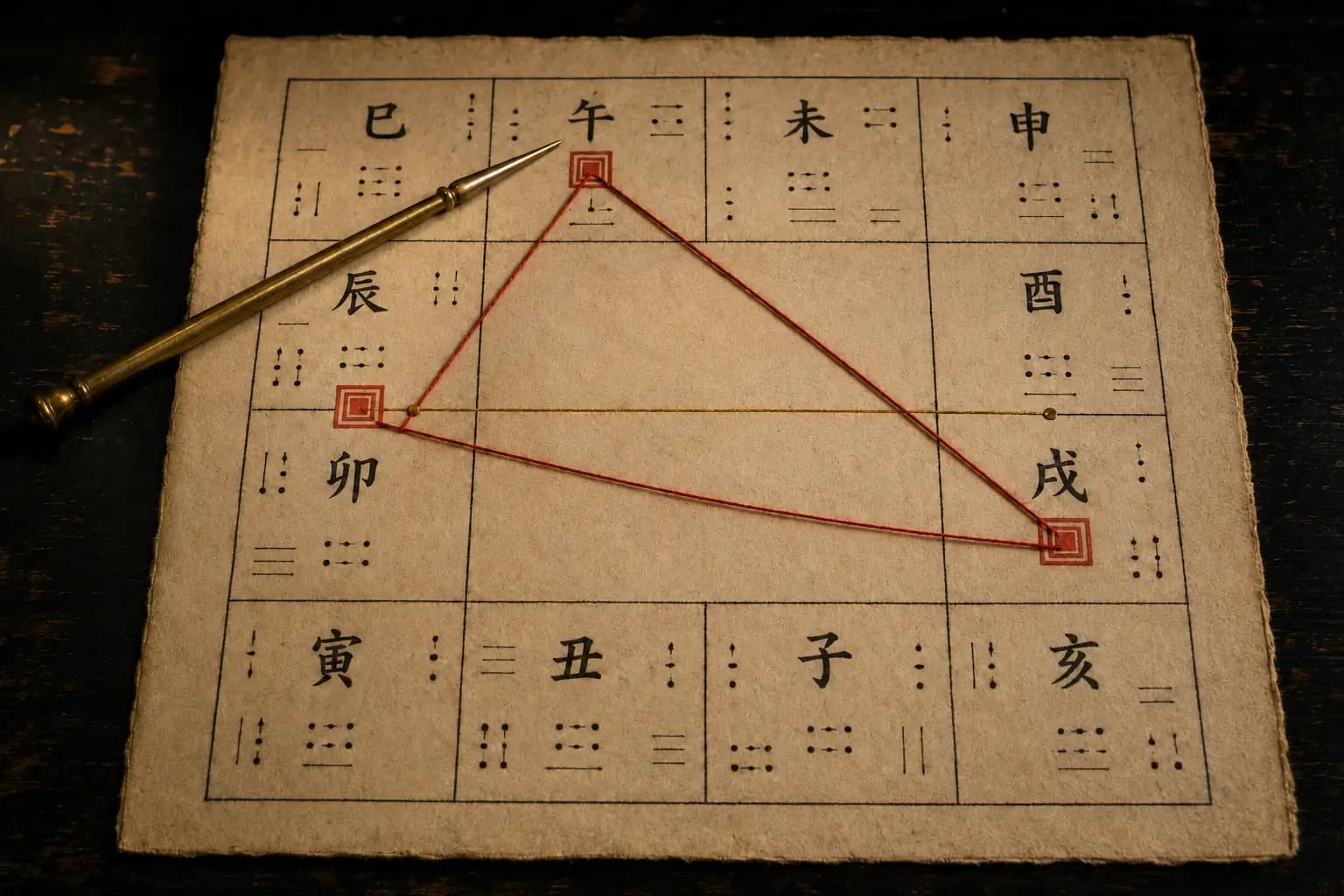
A foundational rule in classical manuals is never to read a single cell in isolation. Every palace operates inside the Three Harmonies and Four Cardinal Positions: the focal palace itself, its directly opposing palace six branches across the grid, and the two trine palaces spaced four branches away on either side to form an equilateral triangle.
When reading the Life Palace, for example, a practitioner simultaneously weighs the opposing Travel Palace together with the trine Career Palace and Wealth Palace. A quiet Life Palace paired with an energetic Travel Palace often describes someone reserved in private yet decisive and adaptable in public roles. Careful readers also check adjacent flanking palaces to spot subtle support or restraint.
What birth details are required to cast a chart?
Casting a chart under standard rules requires five inputs: birth year, month, day, birth hour, and gender (used in classical formulas to set the clockwise or counterclockwise progression of ten-year decade cycles). When you enter a Gregorian date, the engine converts it into the Vietnamese lunisolar calendar (UTC+7), accounting for solar boundaries and any leap month.
Because traditional timekeeping divides the twenty-four-hour day into twelve two-hour Earthly Branch intervals starting with Zi hour at 23:00, shifting by even one two-hour window moves the Life Palace and repositions the major stars. Step-by-step mechanics are documented in how to cast a Zi Wei chart from birth date and hour.
Where should a beginner start reading?
Rather than counting auspicious versus challenging star labels, follow a calm four-step order: inspect the Heaven Plate to compare your Na Yin element with the Five-Element Bureau; read the Life Palace and Body Palace across their trine and opposing palaces; move to the specific palace tied to your current question; and finally check the active decade cycle.
Our beginner walkthrough in how to read a Zi Wei chart for beginners illustrates each step in detail, and you can build your own Zi Wei chart at no cost to follow along on a real twelve-palace diagram.