Zi Wei Dou Shu terminology (thuật ngữ Tử Vi) is the specialized vocabulary used in Purple Star Astrology (Tử Vi Đẩu Số) to describe the structural layout of a Zi Wei chart (lá số Tử Vi) and the geometric interactions among its twelve palaces. Mastering this system allows readers to classify star groups, evaluate pattern quality, and track multi-layered timing cycles accurately.
1. Why should beginners master Zi Wei Dou Shu terminology before reading classical texts?
The biggest hurdle when starting introductory Zi Wei Dou Shu self-study is rarely the calendar arithmetic itself, but rather the compact Sino-Vietnamese technical vocabulary that fills classical manuals. Condensed phrases describing a star guarding a target palace, projecting across an opposing axis, or forming an exceptional counter-pattern appear on nearly every page of traditional commentary.
If you look up isolated words alphabetically without context, it is difficult to visualize how those concepts connect spatially across the twelve boxes of a chart. The most effective way to learn this vocabulary is to organize the terms into the five structural layers you naturally scan when reading a complete chart.
Five terminology groups ordered by the chart-reading sequence
This glossary organizes forty-five core technical concepts into five compartments that mirror the exact sequence a practitioner's eyes follow during chart analysis: the structural chart plates, spatial positions and palace interactions, star classifications, pattern states, and temporal transit cycles. If you are brand-new to the system, you may want to read our foundational overview of what a Zi Wei chart is before exploring the detailed reference entries below.
2. Which terms describe the chart plates and the 12 palaces?
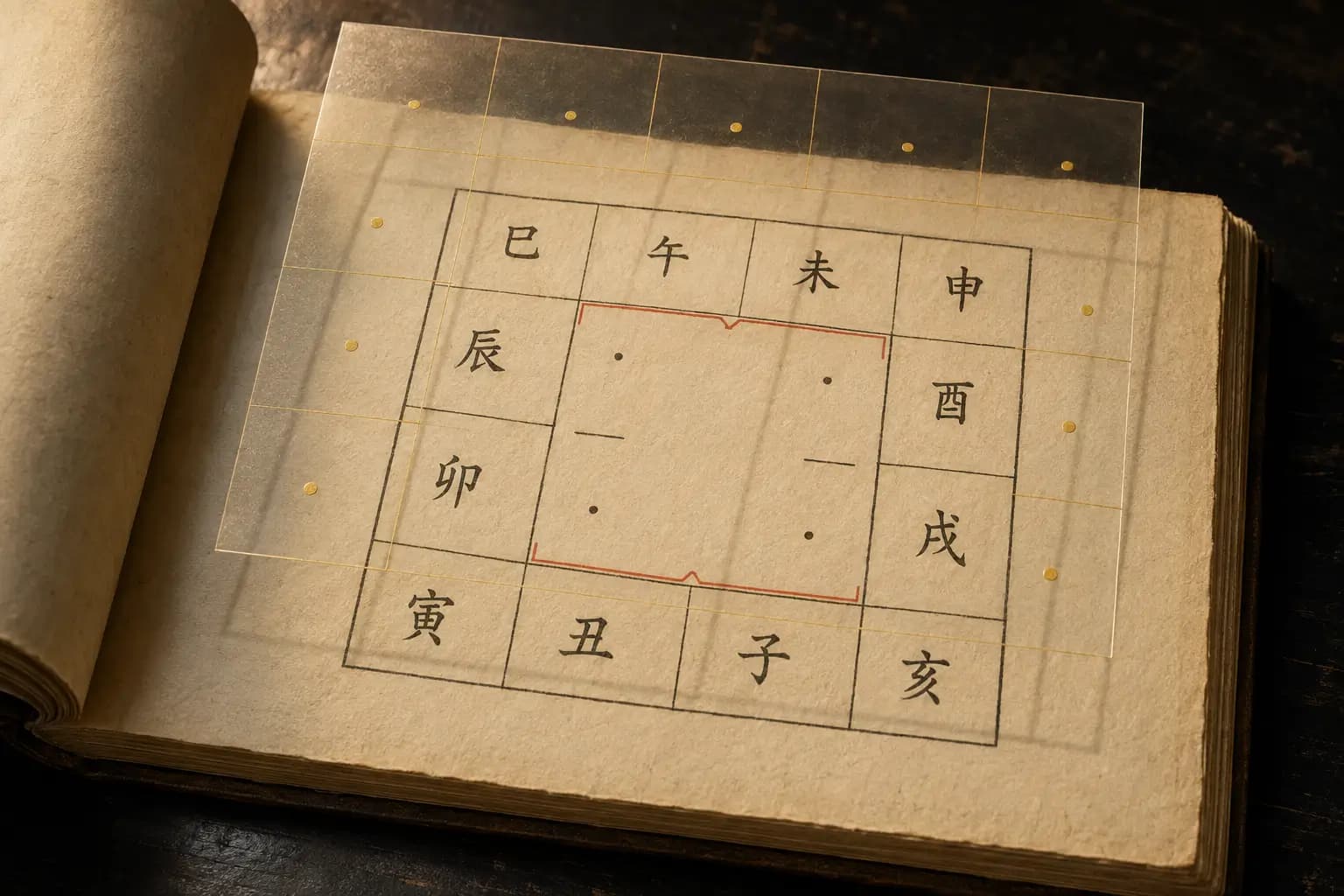
When you open a chart, the entire square grid in front of you is defined by terms that identify spatial zones and foundational birth parameters. Understanding this first group of terms helps you locate every layer of data accurately across the Heavenly Plate and Earthly Plate.
Grouping technical terminology by structural layer helps learners look up concepts as cleanly as sorted bamboo slips.
Terms for foundational birth parameters and the central panel
- Chart Holder (Đương số): The individual whose birth data is used to construct and interpret the Zi Wei chart.
- Heavenly Plate (Thiên bàn): The large central panel of the chart that records the chart holder's name, solar and lunisolar calendar (âm lịch) birth timestamp, natal chart element, bureau number, and guardian lord stars.
- Earthly Plate (Địa bàn): The ring of twelve smaller perimeter boxes surrounding the central panel, permanently anchored to the twelve Earthly Branch (địa chi) positions from Zi to Hai.
- Natal Chart (bản mệnh): The static baseline chart calculated from the birth year, month, day, and hour, reflecting lifelong innate potential.
- Yin-Yang Natural or Inverse Alignment: The harmony or contrast in Yin-Yang (âm dương) polarity between the birth year's Heavenly Stem (thiên can) and the Earthly Branch of the Life Palace (cung Mệnh).
- Five-Element Bureau (Ngũ hành cục): One of the five elemental bureaus (Water 2nd Bureau, Wood 3rd Bureau, Metal 4th Bureau, Earth 5th Bureau, or Fire 6th Bureau) used to place the major star Zi Wei (Tử Vi) and set the starting age of decade cycles.
Terms for grouping palace boxes on the Earthly Plate
- Four Growth Palaces (Tứ Sinh): The four corner palaces at Yin, Shen, Si, and Hai where Tian Ma resides, representing initiative, movement, and new beginnings.
- Four Cardinal Palaces (Tứ Chính): The four mid-side palaces at Zi, Wu, Mao, and You, representing peak concentration, visibility, and interpersonal attraction.
- Four Storage Palaces (Tứ Mộ): The four Earth-element palaces at Chen, Xu, Chou, and Wei, representing resource accumulation, treasury storage, and steady consolidation.
- Body Palace Residence (Thân cư): The placement of the Body Palace (cung Thân) into one of six possible functional palaces (the Life Palace, Fortune Palace, Career Palace, Travel Palace, Wealth Palace, or Spouse Palace) determined by the birth hour.
3. Which terms describe star placement and interactions among palaces?
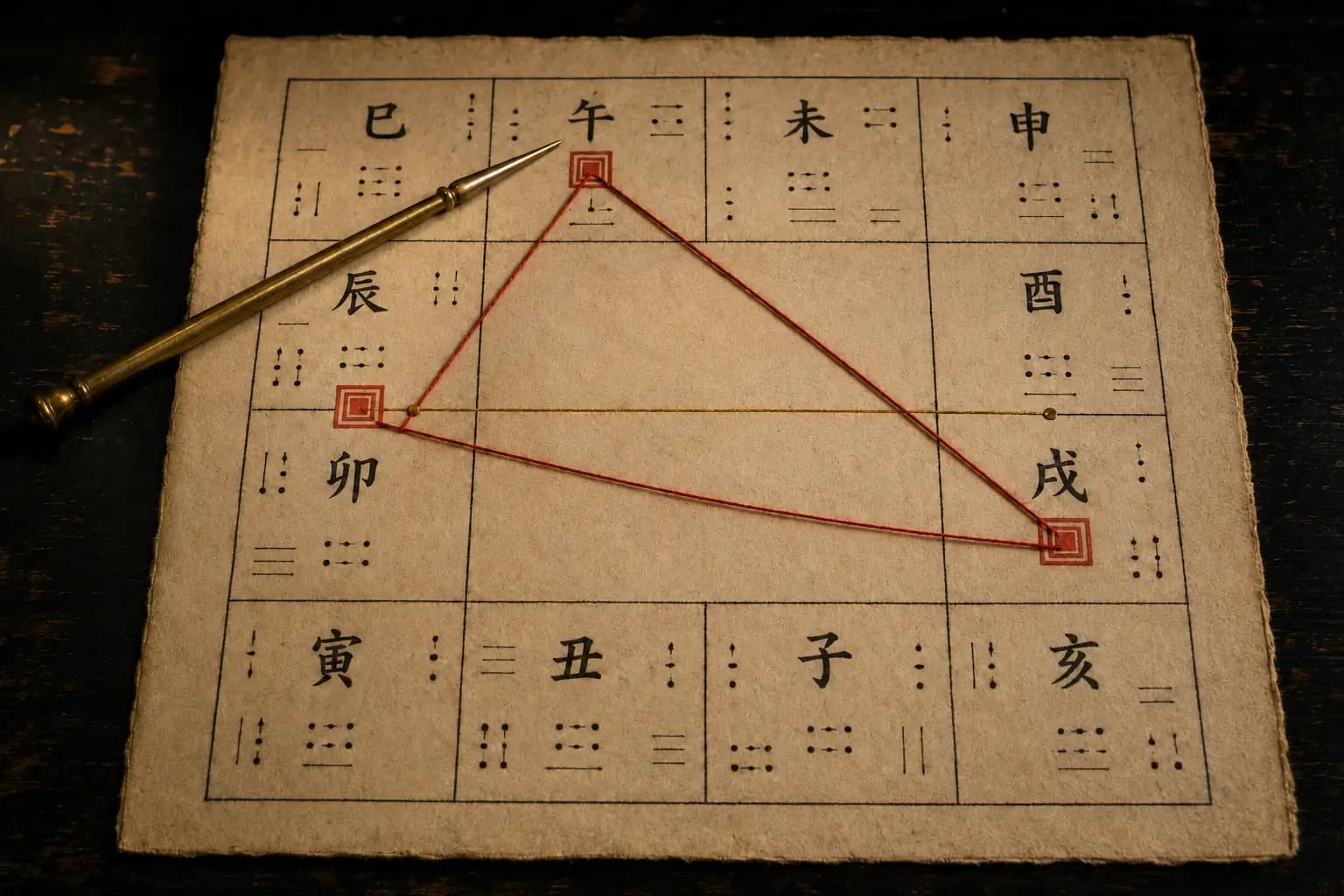
The practical impact of any star on a given palace depends heavily on whether the star sits directly inside that box or projects its influence from another angle on the grid. The terms in the table below form the geometric language of the Three Harmonies and Four Cardinal Positions on a chart.
| Positional Term | Plain English Meaning | Grid Distance | Relative Weight on Target Palace |
|---|---|---|---|
| Target Palace (Bản cung) | The primary palace box currently selected for analysis | In place (0 steps) | Most direct and decisive (40% to 50%) |
| Resident Star (Tọa thủ) | A star stationed directly inside the target palace | In place (0 steps) | Defines the core character and baseline theme of the palace |
| Co-resident Stars (Đồng cung) | Two or more stars sharing the exact same palace box | In place (0 steps) | Blends and modifies the qualities of both stars together |
| Opposing Palace (Xung chiếu) | The palace sitting directly across the center of the chart | 6 steps across | Projects direct external reflection and pressure (25% to 30%) |
| Three Harmonies (Tam hợp) | The two palaces forming an equilateral triangle with the target | 4 steps each way | Supplies supporting context and collaborative resources (25% to 30%) |
| Six Harmonies (Lục hợp) | A horizontally mirrored pair among the 6 Earthly Branch pairs | Mirror axis | Creates quiet, behind-the-scenes resonance between two domains |
| Flanking Palaces (Giáp cung) | The two adjacent palaces immediately to the left and right | 1 step each way | Shelters the target when benefic or squeezes it when malefic |
Distinguishing solo placement, co-residence, and a Palace Without Major Stars
When you inspect the top star line of any palace box, if exactly one star from the fourteen major star (chính tinh) group sits there alone, it is called a solo resident star (Đơn thủ); if two major stars occupy the same box together, they are called co-resident stars. Conversely, if a palace box contains none of the fourteen major stars at all, it is called a Palace Without Major Stars (Vô Chính Diệu), which requires looking across to the opposing palace and Three Harmonies triangle to evaluate its guiding tendencies.
Distinguishing convergence, opposition, and disruptive clash
In technical usage, projection means that a star's energy shines from its home box into another box along the Three Harmonies triangle or across the opposing axis. When supportive stars, such as the Six Benefic Stars or the constructive stars of the Four Transformations (Tứ Hóa), project into the target palace, practitioners call it supportive convergence (Hội chiếu); when Fallen malefic stars project harsh tension across the axis and destabilize a structure, it is called a disruptive clash (Xung phá).
4. Which terms classify stars and structural patterns?
The roster of more than one hundred stars in Zi Wei Dou Shu is organized into a clear hierarchy ranging from primary commanding stars to specialized support stars. Alongside star rank, the Temple, Prosperous, Gained, and Fallen brightness states of stars generate specific terms used to grade the quality of a combination.
Terms for classifying stars
- Major Stars: The fourteen primary stars that serve as the structural pillars of a chart, divided into the six-star Zi Wei ring and the eight-star Tian Fu ring.
- Six Benefic Stars (Lục cát tinh): The six foremost supportive auxiliary star (phụ tinh) companions, comprising Zuo Fu, You Bi, Wen Chang, Wen Qu, Tian Kui, and Tian Yue.
- Six Malefic Stars (Lục sát tinh): The six high-intensity catalytic stars comprising Qing Yang, Tuo Luo, Huo Xing, Ling Xing, Di Kong, and Di Jie.
- Four Transformations: The four stem-activated catalysts comprising Hua Lu (Prosperity Transformation), Hua Quan (Authority Transformation), Hua Ke (Reputation Transformation), and Hua Ji (Friction Transformation).
- Three or Four Void Stars: The group of stars associated with emptiness, detachment, or sudden reversal, including Xun Kong, Jie Kong, Di Kong, and Tian Kong.
Terms for the status of structural patterns
- Structural Pattern (Cách cục): A rule-governed combination of multiple stars converging across the Three Harmonies and Four Cardinal Positions that defines a recognizable temperament or career archetype.
- Well-Formed Pattern (Đắc cách): A state in which the primary stars of a pattern sit in bright Temple (Miếu), Prosperous (Vượng), or Gained (Đắc) positions, gather supportive benefic stars, and remain free of heavy disruption.
- Broken Pattern (Phá cách): A state in which an otherwise promising pattern is weakened by Fallen (Hãm) malefic stars or Hua Ji converging directly into the structure.
- Moderation and Relief (Chế hóa): The mechanism by which a supportive star or Five Elements (ngũ hành) principle tempers and redirects the harshness of a malefic star.
- Counter-Pattern Breakthrough (Phản vi kỳ cách): Special configurations where a Palace Without Major Stars, a Fallen star, or a malefic star interacts constructively with void stars or elemental triggers to produce extraordinary breakthroughs.
> Note: When you encounter poetic classical pattern names in old manuals, never translate their imagery literally to praise or frighten yourself. Those classical names served as mnemonic metaphors to help students remember star combinations; in modern interpretation, every pattern should be translated into concrete cognitive habits, communication styles, and practical workplace behaviors.
5. How are time-cycle and transit terms understood?
Purple Star Astrology does not stop at a static snapshot taken at birth; it tracks how potential unfolds across ten-year chapters and individual years. You can explore our dedicated guide on decade cycles and annual minor cycles on a Zi Wei chart to see how these temporal layers interlock.
Time concepts from 10-year cycles to monthly transits
- Decade Cycle (đại vận): A ten-year lunisolar period anchored in one specific palace box on the Earthly Plate, advancing sequentially from the Life Palace at an age set by the Five-Element Bureau.
- Annual Minor Cycle (tiểu vận): A one-year lunisolar transit calculated from the birth year's Three Harmonies branch group and the chart holder's gender.
- Annual Transit (lưu niên): The one-year lunisolar transit anchored in the Earthly Plate box matching the Earthly Branch of the current calendar year under review.
- Transit Stars (Lưu tinh): Dynamic yearly stars placed afresh for each calendar year to highlight specific triggers and events during that twelve-month window.
- Monthly Transit (Nguyệt hạn): The one-month lunisolar sub-cycle traced from the annual transit palace using the birth month and birth hour.
Key points
- The Heavenly Plate is the central parameter panel, while the Earthly Plate is the ring of 12 fixed Earthly Branch boxes.
- Resident and co-resident stars act directly inside a palace, whereas converging and opposing stars project from across the chart.
- The 14 major stars form the structural core, while the Six Benefic Stars, Six Malefic Stars, and Four Transformations drive dynamic variation.
- The natal chart reflects lifelong baseline potential, whereas the 10-year decade cycle and annual transit reveal active timing.
Would you like to look up the meaning of each technical term displayed directly inside the twelve palaces of your own chart? You can generate your personal Zi Wei chart for free to read a clear, structured modern interpretation tailored to your birth data.
Frequently asked questions
What do benefic transformation and malefic activation mean in Zi Wei Dou Shu articles?
Benefic transformation (Cát hóa) describes a palace shifting toward constructive outcomes thanks to the convergence of Hua Ke, Hua Quan, Hua Lu, or the Six Benefic Stars, whereas malefic activation (Hung hóa) describes heightened friction when Hua Ji converges alongside malefic stars.
How do Pattern and Bureau differ when used as standalone terms?
When used alone, Bureau refers to the Five-Element Bureau recorded in the central Heavenly Plate, whereas Pattern refers to a structural combination of stars converging across the Three Harmonies and Four Cardinal Positions.
What do Prenatal and Postnatal refer to in Zi Wei Dou Shu?
Prenatal (Tiên thiên) refers to innate baseline tendencies represented by the natal chart and the Life Palace, whereas Postnatal (Hậu thiên) refers to personal effort, environment, the ten-year decade cycles, and mature development reflected in the Body Palace after age thirty.
What is a target palace, and is the target palace always the Life Palace?
No, the target palace is simply a technical term for whichever palace box you are currently placing at the center of your analytical focus at that moment.
Sources
- Vân Đằng Thái Thứ Lang, Revised Zi Wei Dou Shu: Standardized terminology of the Southern Vietnamese Zi Wei Dou Shu lineage.
- Nguyễn Phát Lộc, Comprehensive Zi Wei Dou Shu: Glossary definitions covering palace geometry, star classifications, and interpretive rules.
- Chen Tuan (Trần Đoàn, Hi Di), Zi Wei Dou Shu Complete Compendium: Classical foundations of structural patterns, the Three Harmonies and Four Cardinal Positions, and timing cycles.