How are the twelve two-hour Earthly Branches defined?
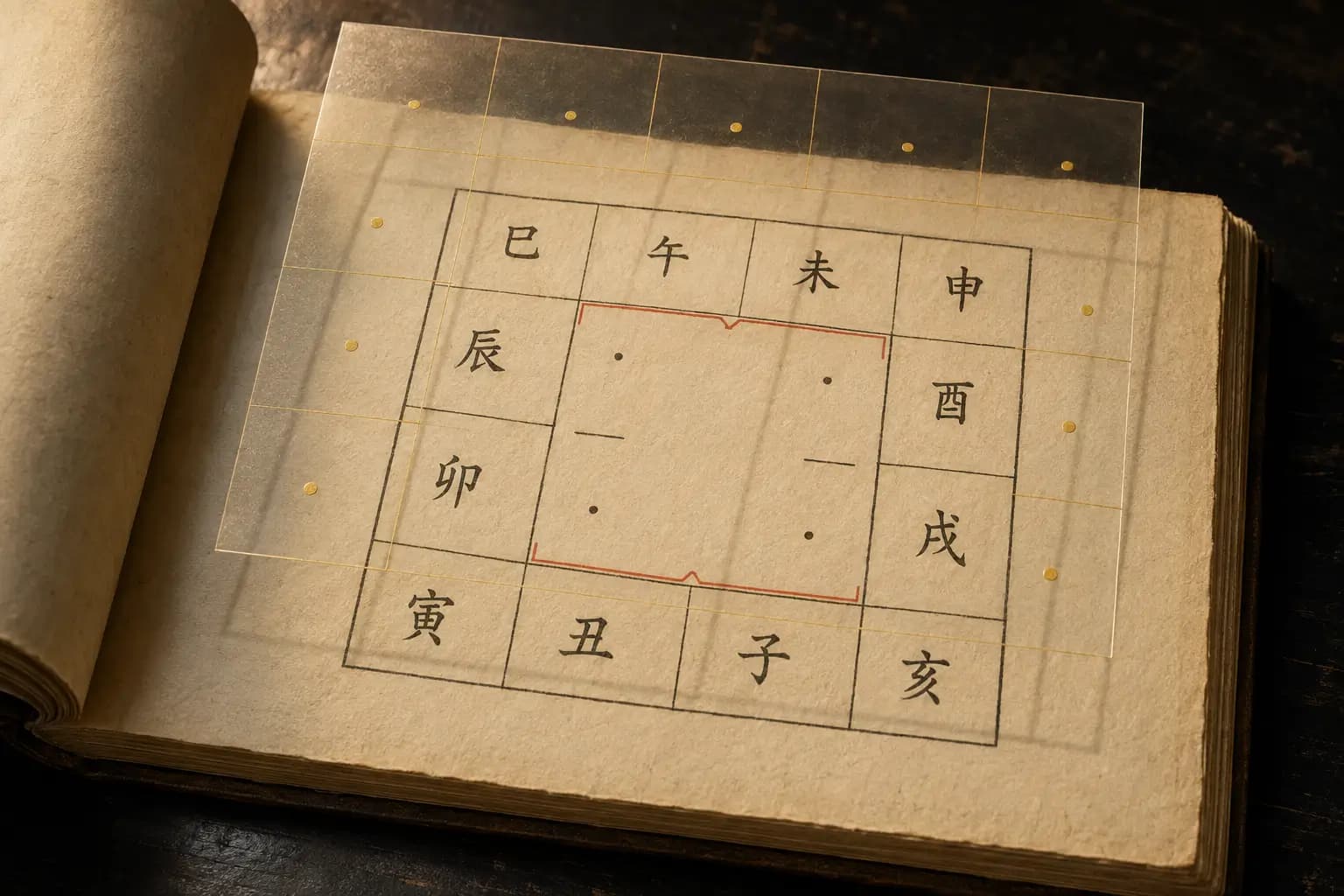
Traditional East Asian timekeeping divides twenty-four hours into twelve equal two-hour intervals named after the Earthly Branches. In Purple Star Astrology (Tử Vi Đẩu Số), the cycle opens with Zi hour from 23:00 to 00:59 — spanning midnight across two civil dates — and continues in two-hour steps through Chou (01:00–02:59), Yin (03:00–04:59), Mao (05:00–06:59), right up to Hai hour from 21:00 to 22:59 before placing Zi Wei (Tử Vi) and the twelve palaces.
Whenever a recorded birth time sits comfortably near the middle of a two-hour window (such as 09:35 inside Si hour or 15:40 inside Shen hour), branch assignment is straightforward and insensitive to minor wall-clock drift.
| Earthly Branch hour | Clock interval | Time of day | Resulting Body Palace placement |
|---|---|---|---|
| Zi hour | 23:00 – 00:59 | Late night (midnight span) | Body co-resides in Life Palace |
| Chou hour | 01:00 – 02:59 | Early pre-dawn | Body in Fortune Palace |
| Yin hour | 03:00 – 04:59 | Daybreak | Body in Career Palace |
| Mao hour | 05:00 – 06:59 | Sunrise | Body in Travel Palace |
| Chen hour | 07:00 – 08:59 | Morning | Body in Wealth Palace |
| Si hour | 09:00 – 10:59 | Late morning | Body in Spouse Palace |
| Wu hour | 11:00 – 12:59 | Midday | Body co-resides in Life Palace |
| Wei hour | 13:00 – 14:59 | Early afternoon | Body in Fortune Palace |
| Shen hour | 15:00 – 16:59 | Late afternoon | Body in Career Palace |
| You hour | 17:00 – 18:59 | Dusk | Body in Travel Palace |
| Xu hour | 19:00 – 20:59 | Evening | Body in Wealth Palace |
| Hai hour | 21:00 – 22:59 | Night | Body in Spouse Palace |
Which parts of a Zi Wei chart depend directly on birth hour?
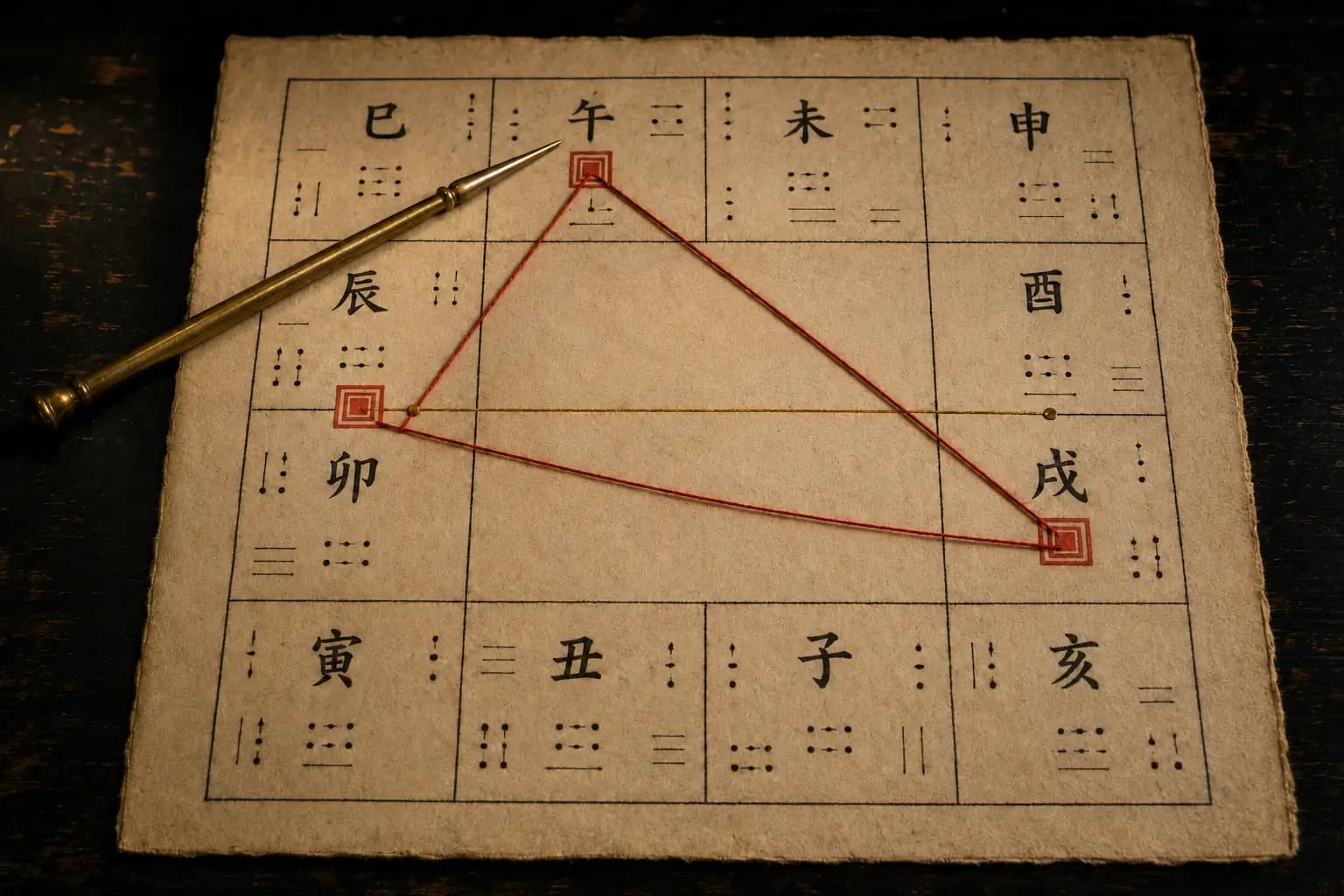
Birth hour combines with the lunisolar birth month to anchor both the Life Palace and Body Palace. Shifting the Life Palace by even one cell rotates all eleven remaining palace labels around the grid and commonly changes the Five-Element Bureau (for example, from Wood 3rd Bureau to Water 2nd Bureau or Fire 6th Bureau), which in turn moves Zi Wei, Tian Fu, and the rest of the fourteen major stars into an entirely new pattern.
Several influential auxiliary stars are also placed directly from the birth-hour branch rather than the birth year or month, including the literary pair Wen Chang and Wen Qu, the Void pair Di Kong and Di Jie, the dynamic pair Huo Xing and Ling Xing, as well as Tai Fu and Feng Gao. Review the full chain in how a Zi Wei chart is calculated.
How much changes if birth time is off by one branch?
A thirty-minute difference inside one branch (such as 07:20 versus 07:50 inside Chen hour) produces the exact same twelve-palace chart, whereas a ten-minute difference across an odd-hour boundary (08:55 in Chen hour versus 09:05 in Si hour) produces two structurally distinct charts with different Life Palace stars, different Body Palace domains, and different decade starting ages.
What remains unchanged across same-day candidate branches are year-keyed and month-keyed markers: birth-year Na Yin Five Elements, the birth-year Four Transformations (Hua Lu, Hua Quan, Hua Ke, Hua Ji), Lu Cun, Zuo Fu, You Bi, Tian Kui, and Tian Yue still occupy the same Earthly Branch cells, even though the palace names sitting on those cells shift.
What if you were born near an odd-hour boundary or during Zi hour?
When hospital records show a time within ten to fifteen minutes of an odd clock hour (such as 04:55, 05:05, 10:58, or 13:02), experienced practitioners cast both adjacent branches side by side and compare temperament, career leanings, household context, and past ten-year turning points rather than assuming the delivery-room wall clock was calibrated to the minute.
For Zi hour (23:00–00:59), practitioners distinguish early Zi (23:00–23:59 before midnight) from late Zi (00:00–00:59 after midnight). Because civil calendars advance the date at 00:00 while traditional branches open Zi at 23:00, checking which lunisolar day convention was applied prevents a full one-day shift in star placement.
How reliable are birth certificates and family recollections?
Hospital birth certificates and maternity bracelets are the strongest starting documents, though clinical staff occasionally log the timestamp after initial neonatal care or round entries to the nearest half hour. Older home births recalled through everyday rural or urban phrases ('around first rooster call', 'near noon meal', 'just after dusk') carry wider two-to-four-hour windows.
Historical timezone adjustments in Vietnam are equally important for older generations: certain periods prior to 1975 in both northern and southern regions operated under UTC+8 rather than modern UTC+7, meaning a recorded 09:15 clock entry from an eight-hour zone corresponds to 08:15 under standard seven-hour time — crossing back from Si hour into Chen hour.
What should you do when your exact birth hour is unknown?
Follow three disciplined steps: first, narrow the time window with parents, elder relatives, or archival hospital logs; second, cast the two or three plausible candidate charts and compare verifiable past milestones rather than forcing vague traits to fit; third, keep any unconfirmed chart clearly labeled as provisional so hour-dependent readings are never over-interpreted. Start transparently on our Zi Wei chart calculator, and read how reliable is Purple Star Astrology plus Life Palace, Body Palace, and Bureau explained.