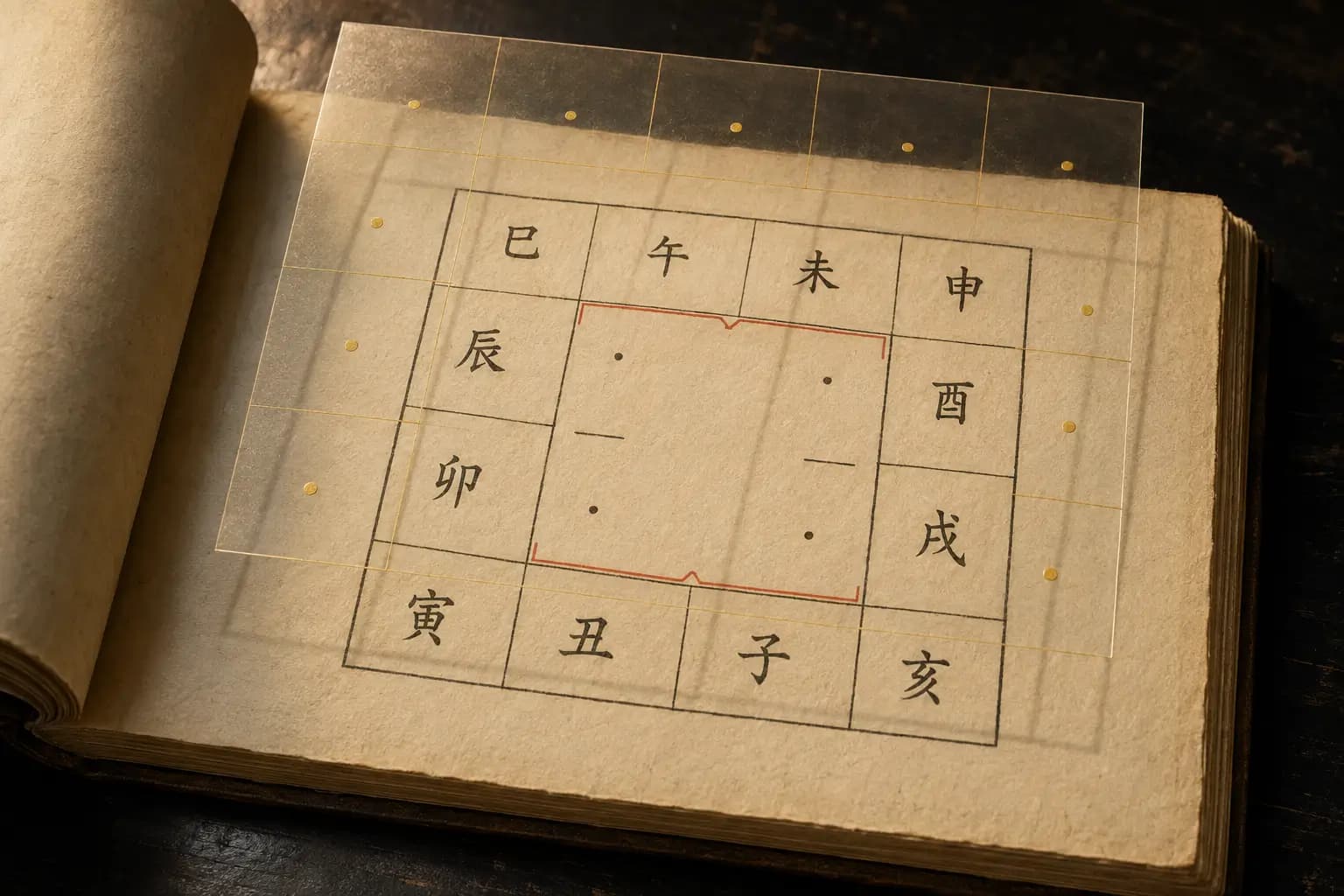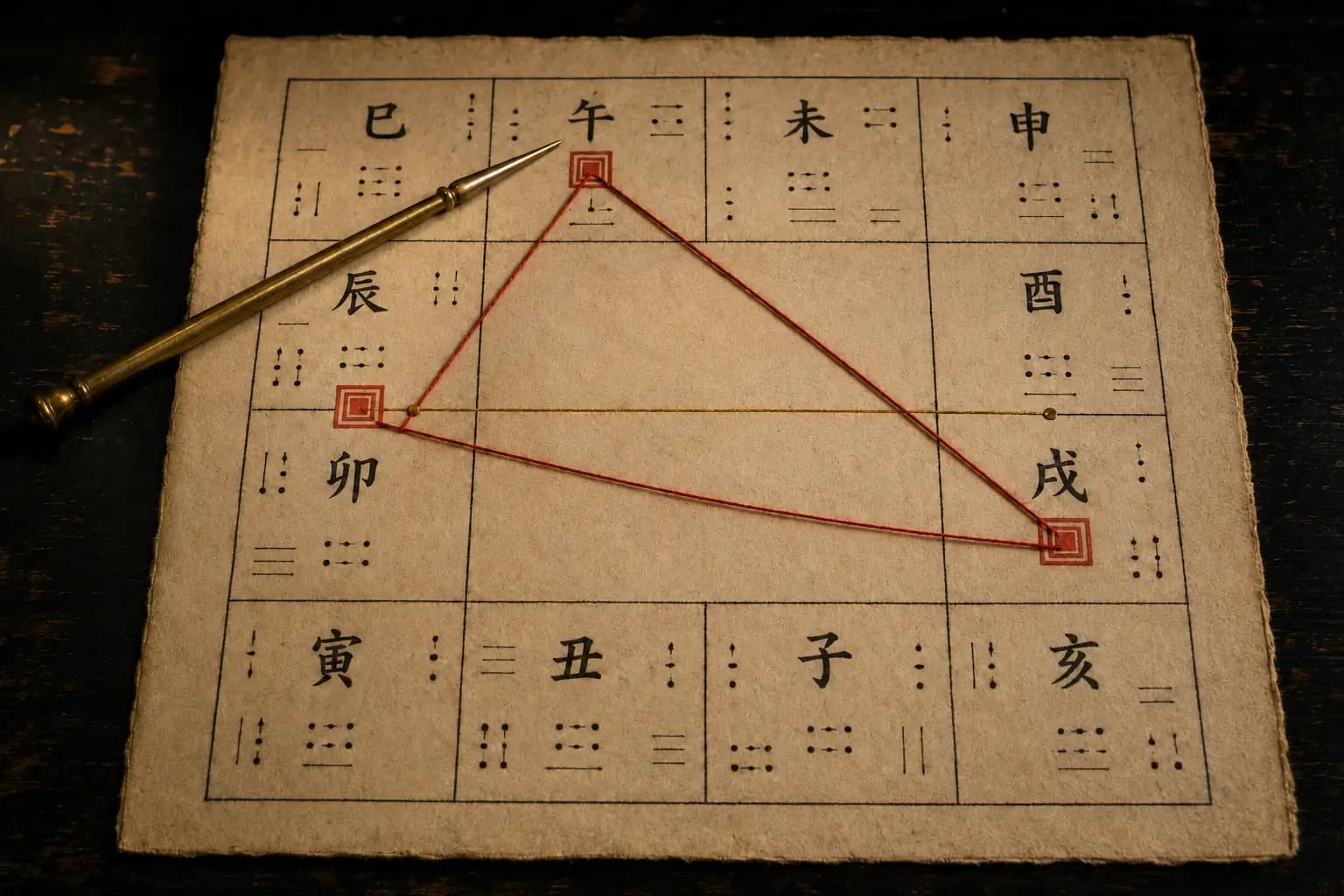
Temple (Miếu), Prosperous (Vượng), Gained (Đắc), Neutral (Bình), and Fallen (Hãm) are the five foundational grades that measure the brightness and energetic strength of a star on a Zi Wei chart (lá số Tử Vi). Depending on which Earthly Branch (địa chi) palace a star occupies, Vietnamese charts abbreviate these levels in parentheses as (M), (V), (D / Đ), (B), and (H), while some classical tables also note an Unfavorable (Bất) sub-grade.
1. What do the brightness abbreviations (M, V, D, B, H) mean on a chart?
As you inspect the twelve palace cells while studying foundational Zi Wei Dou Shu, you will notice an uppercase letter in parentheses immediately following the name of each major star (chính tinh). Those shorthand markers (M), (V), (D), (B), and (H) indicate the luminosity and positional suitability of the star inside the specific palace cell where it resides.
In Purple Star Astrology (Tử Vi Đẩu Số), each star acts like a seed carrying its own innate temperament, while the twelve Earthly Branch cells resemble twelve geographic terrains with distinct seasonal climates. A seed planted in soil and climate that match its nature grows effortlessly and radiates its best qualities; when placed in a harsh or mismatched terrain, it requires external support and deliberate cultivation to thrive.
| Symbol | Traditional Stage | Canonical English Grade | Expression of Star Qualities in the Palace |
|---|---|---|---|
| (M) | Temple placement | Temple: Maximum Brilliance | The star sits in its most congenial position and expresses its constructive traits in full. |
| (V) | Prosperous placement | Prosperous: Strong Vitality | The star commands abundant developmental momentum, ranking just behind Temple brightness. |
| (D) | Gained placement | Gained: Suitable Ground | The star occupies a practical, supportive cell and performs reliably when given clear direction. |
| (B) | Neutral placement | Neutral: Balanced State | The star remains steady and moderate, neither exceptionally radiant nor depleted of strength. |
| (H) | Fallen placement | Fallen: Restricted State | The star enters an elementally constrained environment, making it prone to friction unless supported by rescue factors. |
Three constructive brightness states: Temple (M), Prosperous (V), and Gained (D)
The grade Temple signifies a star seated upon an elevated dais, expressing its purest virtues, such as when Zi Wei (Tử Vi) resides at Wu (Ngọ) or Tai Yang (Thái Dương) resides at Si (Tỵ) or Wu. One step below is Prosperous (V), which reflects vigorous growth energy, followed by Gained (D), which indicates that the star has found suitable ground to apply its practical capabilities.
Two neutral and challenging states: Neutral (B) and Fallen (H)
In the middle of the scale sits Neutral (B), where a star's baseline energy is balanced and its real-world outcome depends heavily on the auxiliary stars (phụ tinh) converging from linked palaces. At the lower end is Fallen (H), describing a star placed in an incompatible environment where its energy is constrained, meaning the native often experiences steeper early learning curves if mitigating stars are absent.
2. Why does the same star change brightness across different Earthly Branch palaces?
Beginners frequently wonder why a star's brightness grade is fixed by its palace cell rather than changing according to a person's birth year. The answer lies in the interaction of the Five Elements (ngũ hành) and the diurnal cycle mapped across the twelve cells of the Heaven Plate and Earth Plate (thiên bàn địa bàn).
Every star in the system carries an intrinsic element (Metal, Wood, Water, Fire, or Earth) alongside a natural astronomical image. Whenever a star is placed into one of the twelve Earthly Branch palaces, the elemental harmony or restriction between the star and the palace determines its brightness grade.
The five grades Temple, Prosperous, Gained, Neutral, and Fallen reflect how naturally a star's intrinsic element harmonizes with the environment of its Earthly Branch palace.
The principle of Five Elements generation and Earthly Branch position
When the element of an Earthly Branch palace generates or matches the intrinsic element of a star, the star receives supportive vitality and naturally attains Temple, Prosperous, or Gained brightness. Conversely, when a star lands in a palace whose element strongly restricts or drains its own element, its luminosity drops toward Neutral or Fallen.
The daytime and nighttime imagery governing Tai Yang and Tai Yin
Beyond elemental interaction, classical masters also used the daily solar and lunar cycle to assign brightness grades to Tai Yang (the Sun) and Tai Yin (Thái Âm) (the Moon). The daytime palaces running from Yin (Dần) through Wu allow Tai Yang to shine brightly while dimming Tai Yin; conversely, the nighttime palaces from You (Dậu) through Zi (Tý) elevate Tai Yin to Temple and Prosperous brilliance while placing Tai Yang into a Fallen state.
3. How does star brightness differ between the 14 major stars and the Six Malefic Stars?
An essential rule when interpreting the markers (M, V, D, B, H) is distinguishing whether the star under review belongs to the fourteen major stars or the Six Malefic Stars (Lục sát tinh). To understand the baseline temperament of the fourteen core stars before evaluating their brightness, you can review our guide to the 14 major stars in Zi Wei Dou Shu.
Seeing the marker (H) does not carry the same weight for every star. In particular, among the malefic stars, the gap between Gained brightness and Fallen brightness produces two sharply contrasting behavioral outcomes.
For the 14 major stars: Brightness shapes ease of expression and durability
For the fourteen major stars, occupying a Temple, Prosperous, or Gained position is like placing a skilled specialist into a role that matches their training, allowing constructive qualities to surface smoothly. When a major star falls into a Fallen position, its core talent does not vanish, but the individual must cultivate patience and practical resilience to overcome initial friction.
For the Six Malefic Stars: Gained brightness brings drive, Fallen brightness brings friction
When the Six Malefic Stars, namely Qing Yang (Kình Dương), Tuo Luo (Đà La), Huo Xing (Hỏa Tinh), Ling Xing (Linh Tinh), Di Kong (Địa Không), and Di Jie (Địa Kiếp), sit at Gained (D) or Temple and Prosperous (M, V) brightness, their intense energy converts into courage, decisive execution, and rapid technical breakthroughs. Conversely, when these malefic stars land in a Fallen (H) state, their sharp edge easily manifests as impulsiveness, impatience, or unnecessary wear and tear.
4. Does having a Fallen star in the Life Palace mean a bad chart?
Many newcomers feel anxious when they spot the symbol (H) inside their Life Palace (cung Mệnh), Career Palace (cung Quan Lộc), or Spouse Palace (cung Phu Thê). In rigorous chart interpretation, however, an analyst never labels an entire chart unfavorable simply because one or two stars occupy a Fallen position.
Classical texts consistently emphasize the principles that a single star never dictates the whole chart and that a Fallen star meeting supportive factors is revived. In practice, many charts with a Fallen major star in the Life Palace achieve remarkable professional success thanks to well-structured converging palaces.
> Note: Never judge a Fallen star in isolation within its home palace. Before drawing any conclusion, always inspect all four linked palaces across the Three Harmonies and Four Cardinal Positions (tam phương tứ chính), check for the presence of the constructive transformations in the Four Transformations (Tứ Hóa), and verify whether Void or Interception markers modify the palace.
The mitigating mechanism of the Six Benefic Stars and the Three Constructive Transformations
When a major star in a Fallen position converges with multiple Six Benefic Stars (Lục cát tinh), namely Zuo Fu (Tả Phụ), You Bi (Hữu Bật), Wen Chang (Văn Xương), Wen Qu (Văn Khúc), Tian Kui (Thiên Khôi), and Tian Yue (Thiên Việt), together with Hua Ke (Hóa Khoa), Hua Quan (Hóa Quyền), and Hua Lu (Hóa Lộc), its limitations are substantially neutralized. This structure reflects a person who uses continuous education, structured planning, and reliable teamwork to turn early challenges into competence.
The reversing effect of Cycle Void (Tuần) and Path-Severing Void (Triệt) in a Fallen palace
When a major star or malefic star sitting in a Fallen (H) state encounters Cycle Void or Path-Severing Void stationed directly in that same palace, classical theory describes the effect as restraining the undesirable friction while unlocking latent constructive energy. Especially for Tai Yang and Tai Yin in Fallen positions, a well-placed Cycle Void or Path-Severing Void marker can brighten the overall configuration.
5. What is the 4-step process for evaluating a star by its brightness level?
To apply a standard method for reading a Zi Wei chart objectively, avoid reducing the analysis to a simplistic rule where (M) means good and (H) means bad. Instead, follow the four sequential steps below whenever you evaluate any palace on the grid.
Step 1 and Step 2: Check home-palace brightness and compare with the natal Na Yin element
First, note the (M, V, D, B, H) grade of the major star in the target palace and weigh how co-located stars balance each other if two major stars share the cell. Second, compare the star's intrinsic element against the Na Yin Five Elements (Ngũ hành nạp âm) of your natal chart (bản mệnh): a star whose element generates or harmonizes with your natal element always provides steadier support.
Step 3 and Step 4: Scan converging benefic stars and track the decade cycles
In step three, look across to the opposing palace and the two palaces in the Three Harmonies (Tam hợp) triangle to count how many benefic stars, constructive transformations, or Void and Interception markers converge. Finally, place the star into the moving timeline of ten-year decade cycles (đại vận) to identify when its potential is practically activated.
Key points
- The five star brightness grades from highest to lowest are Temple, Prosperous, Gained, Neutral, and Fallen.
- Brightness is governed by Five Elements interactions and the day-night cycle across the twelve Earthly Branch palaces.
- Six Malefic Stars at Gained brightness provide strong breakthrough drive, whereas Fallen placements create friction.
- A Fallen star supported by the Six Benefic Stars, Hua Lu, Hua Quan, Hua Ke, or Cycle Void and Path-Severing Void can still perform constructively.
Want to check whether the major stars in your Life Palace, Career Palace, and Wealth Palace (cung Tài Bạch) sit at Temple, Prosperous, Gained, Neutral, or Fallen brightness? You can generate your personal Zi Wei chart for free to view an accurate star layout with complete brightness markers.
Frequently asked questions
Why do some smaller auxiliary stars have no (M, V, D, B, H) marker next to them?
On a Zi Wei chart, the five-tier brightness scale is systematically applied to the fourteen major stars and the primary auxiliary stars, whereas minor secondary stars are interpreted directly through the star combinations they join.
How do you read a palace where two major stars share the cell, but one is at Temple and one is Fallen?
When two co-located major stars carry different brightness grades, the star sitting at Temple or Prosperous brightness takes the leading role in setting the palace's tone and helps stabilize the Fallen partner alongside it.
Is there a large practical gap between Neutral (B) and Gained (D) brightness?
A star at Gained brightness expresses its core strengths more proactively and distinctly, whereas a star at Neutral brightness operates with a moderate baseline and readily absorbs the tone of the stars converging from linked palaces.
Why does one reference book list a star as Gained while another lists it as Prosperous in the same palace?
Classical lineages occasionally differ by one adjacent grade in a few palace cells, yet the fundamental boundary between the bright group (Temple, Prosperous, Gained) and the restricted group (Fallen) remains consistent across traditions.
Sources
- Vân Đằng Thái Thứ Lang, New Compendium of Purple Star Astrology: Reference tables of Temple, Prosperous, Gained, Neutral, and Fallen brightness for the 14 major stars and primary auxiliary stars across the 12 Earthly Branch palaces.
- Chen Tuan (Trần Đoàn, Hi Di), Complete Compendium of Purple Star Astrology: Discourse on Star Brightness and Restriction and rules for mitigating Fallen major stars.
- Nguyễn Phát Lộc, Comprehensive Zi Wei Synthesis: Analysis of the Five Elements and astronomical time cycles governing star luminosity.