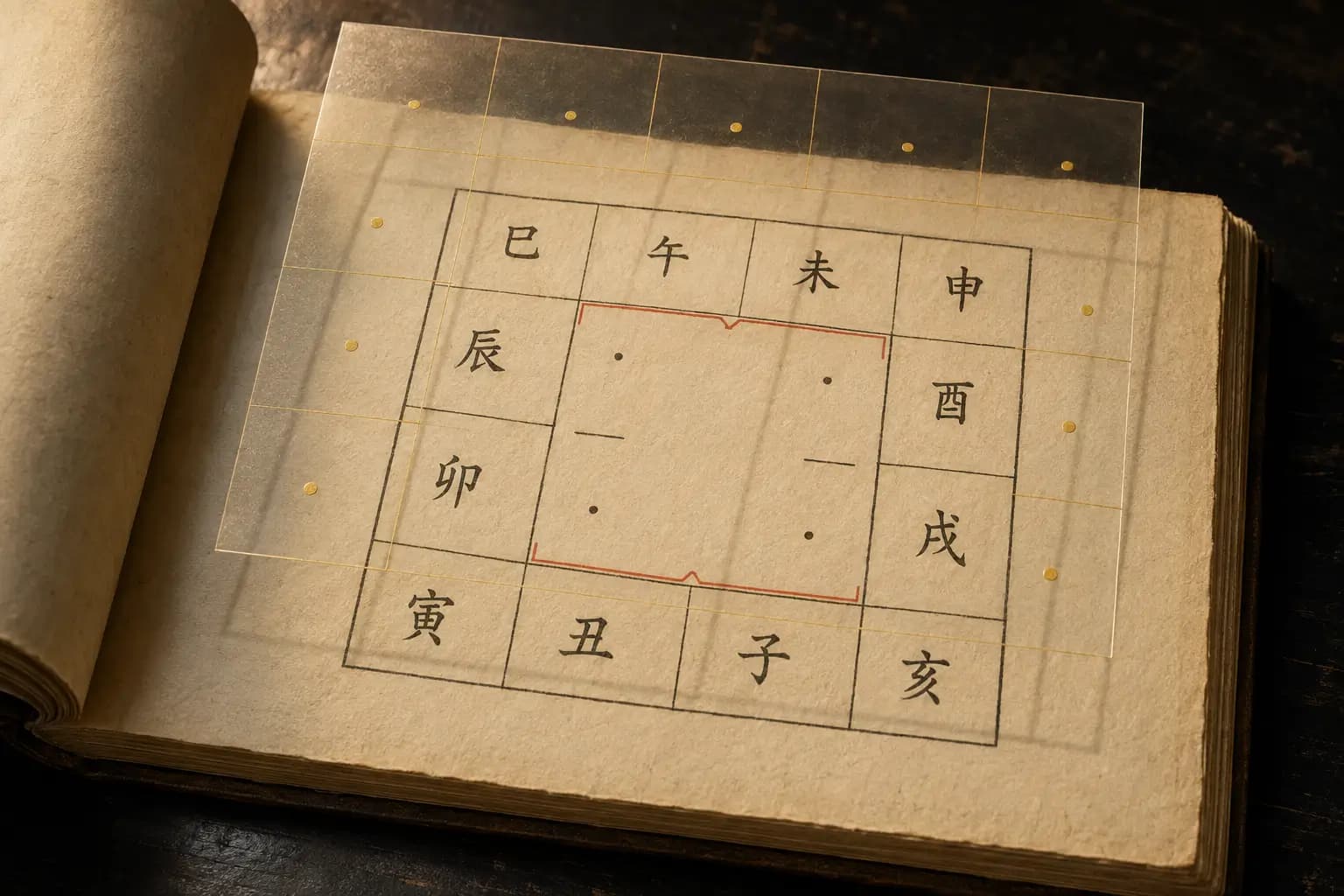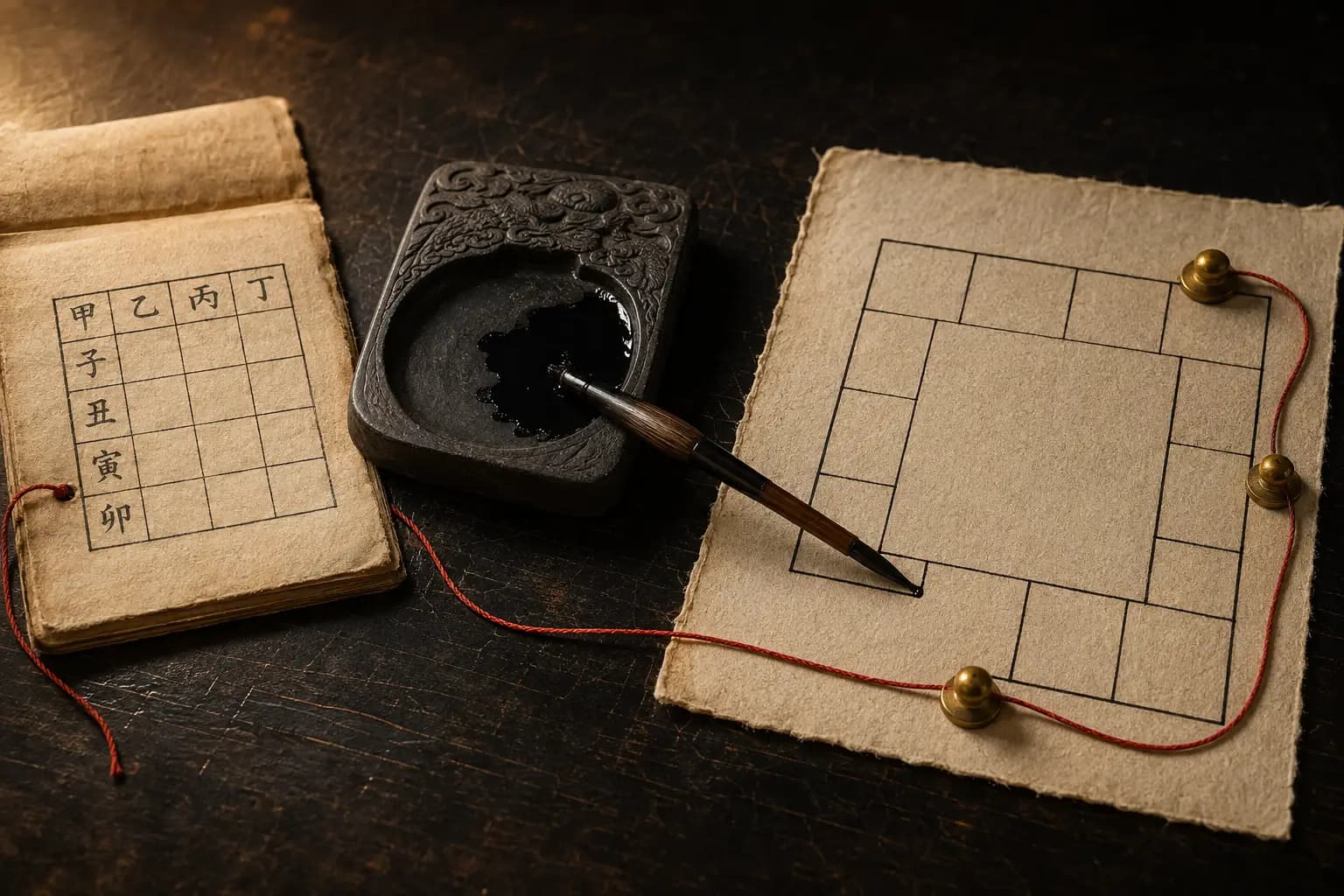
The Heavenly Plate (Thiên bàn) and Earthly Plate (Địa bàn) are the two structural frames that form the face of a Zi Wei chart (lá số Tử Vi). They consist of the large central panel recording birth data, natal element, and bureau number, surrounded by twelve perimeter palace boxes permanently anchored to the twelve Earthly Branch (địa chi) positions from Zi to Hai.
1. What are the Heavenly Plate and Earthly Plate in Zi Wei Dou Shu and why is the chart divided into two parts?
When beginning your journey in introductory Zi Wei Dou Shu self-study, the first thing you encounter on a chart is a tightly organized square grid. In Purple Star Astrology (Tử Vi Đẩu Số), this layout models the classical East Asian cosmology in which cosmic time, earthly space, and human life intersect within a single coordinate frame.
The central panel and the outer perimeter ring perform two distinct yet deeply connected roles. Understanding the structural logic of each region allows a chart reader to grasp the underlying baseline rules of the natal chart (bản mệnh) before zooming in on individual stars.
Meaning of the Heavenly Plate at the center of the chart
On a modern Zi Wei chart, the large open box in the middle is called the Heavenly Plate. This central area records the foundational parameters established at birth, including the chart holder's name, gender, solar and lunisolar calendar (âm lịch) birth date and hour, natal Five Elements (ngũ hành) phase, Five-Element Bureau (Ngũ hành cục), and a concise summary of elemental harmony or tension.
Meaning of the Earthly Plate comprising the 12 surrounding palace boxes
Surrounding the central panel are twelve smaller rectangular boxes arranged along the four sides of the square, known collectively as the Earthly Plate. The positions of the twelve Earthly Branches from Zi through Hai remain permanently fixed in a clockwise loop on every single Zi Wei chart, regardless of when a person is born.
Expanding the classical concept of the Human Plate
Some classical manuals distinguish a third layer called the Human Plate (Nhân bàn) to describe the ring of twelve functional palaces, from the Life Palace (cung Mệnh) through the Siblings Palace (cung Huynh Đệ), that rotates across the underlying Earthly Plate according to birth month and hour. In contemporary practice, students and practitioners usually refer simply to the central summary box as the Heavenly Plate and the twelve outer boxes as the Earthly Plate.
2. Which core parameters are displayed inside the central Heavenly Plate?
Many beginners pick up a chart and skip right past the central Heavenly Plate to look at the stars inside the Life Palace. Overlooking the center is a major analytical mistake because the parameters recorded in the Heavenly Plate set the baseline ease or resistance across every stage of the chart holder's life.
Every line in the Heavenly Plate is derived from the Heavenly Stems and Earthly Branches of the birth year, month, day, and hour. You can review our guide on how to construct an accurate Zi Wei chart to see how each of these core parameters is calculated from calendar data.
| Information Group | Displayed Content | Calculation Source | Role in Chart Interpretation |
|---|---|---|---|
| Birth Timestamp | Solar and lunisolar year, month, day, and hour | Standard lunisolar calendar | Establishes the root coordinates for placing palaces and stars. |
| Yin-Yang Polarity | Yang Male, Yin Male, Yang Female, or Yin Female | Birth-year Heavenly Stem and gender | Determines whether the 10-year decade cycle moves clockwise or counterclockwise. |
| Natal Element | One of the 30 Na Yin Five Elements phases | Lunisolar birth-year stem and branch | Reflects foundational temperament and is compared with the Bureau. |
| Five-Element Bureau | Water 2nd, Wood 3rd, Metal 4th, Earth 5th, or Fire 6th | Birth-year stem and Life Palace branch | Sets the starting age of decade cycles and places the major star Zi Wei. |
| Life and Body Lords | Two guardian stars supporting the natal chart | Life Palace branch and birth-year branch | Provides supplementary insight into inner spiritual and practical anchors. |
The sexagenary cycle birth timestamp and Yin-Yang gender polarity
In the upper portion of the Heavenly Plate, the system displays the four sexagenary cycle (can chi) pairs of the lunisolar year, month, day, and hour, classifying the chart holder as Yang Male, Yin Male, Yang Female, or Yin Female based on the birth year's Yin-Yang (âm dương) polarity. This classification governs the direction of the ten-year decade cycle (đại vận): Yang Males and Yin Females progress clockwise around the chart, whereas Yin Males and Yang Females progress counterclockwise.
The Na Yin Natal Element and Five-Element Bureau lines
Directly beneath the birth timestamp sit the lines recording the Natal Element (drawn from the thirty Na Yin Five Elements, or Ngũ hành nạp âm, phases of the birth year) and the Five-Element Bureau of the Life Palace, which may be Water 2nd Bureau (Thủy nhị cục), Wood 3rd Bureau (Mộc tam cục), Metal 4th Bureau (Kim tứ cục), Earth 5th Bureau (Thổ ngũ cục), or Fire 6th Bureau (Hỏa lục cục). To understand how these pillars interact, see our guide to the Life Palace, Body Palace, and Bureau framework in Zi Wei Dou Shu.
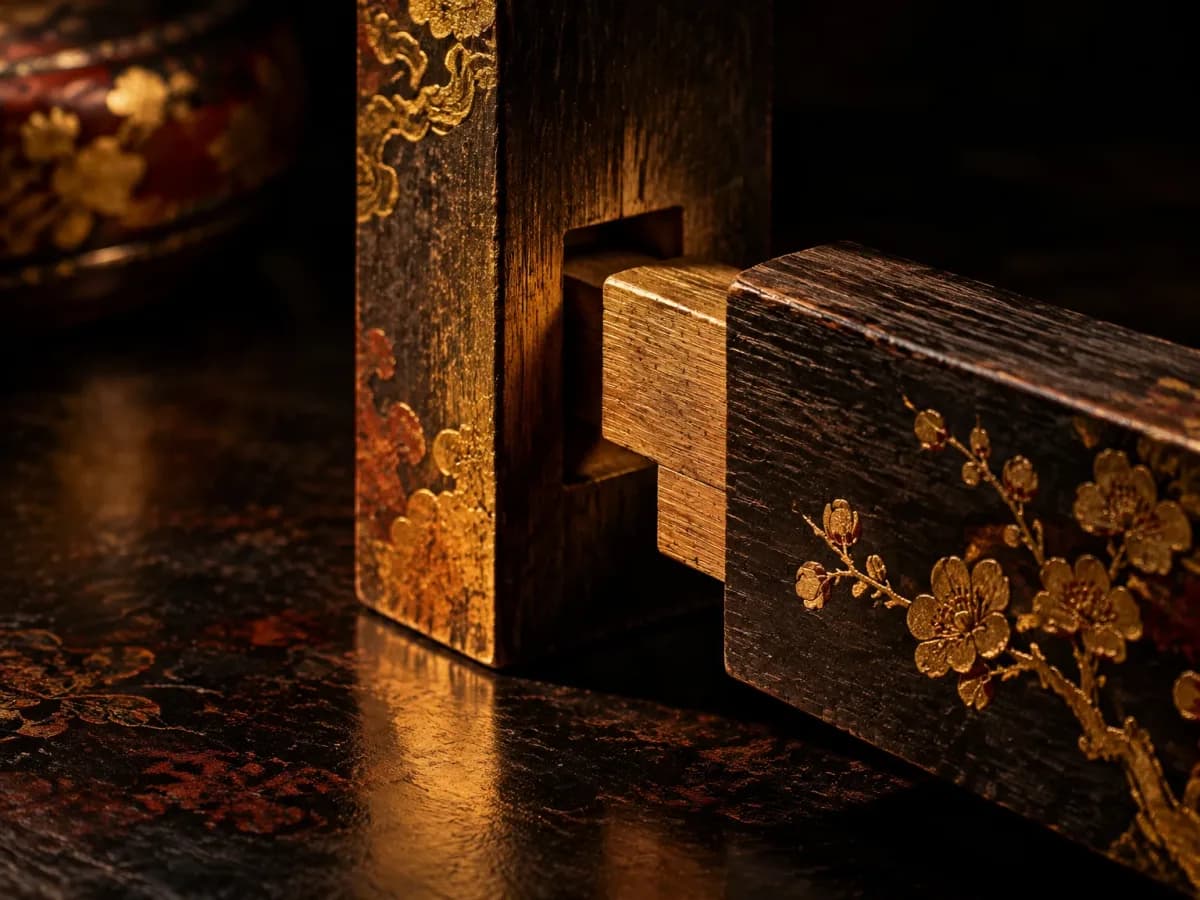
The Heavenly Plate and Earthly Plate interlock like traditional mortise-and-tenon joinery to form a sturdy structural frame for the chart.
3. By what rules are the 12 boxes of the Earthly Plate arranged?
When you shift your gaze from the central Heavenly Plate outward to the twelve surrounding boxes of the Earthly Plate, you will notice that each box organizes dense information across its four corners and center. Structurally, these twelve boxes represent the superposition of the fixed Earthly Branch foundation underneath and the rotating ring of twelve functional palaces above.
Mastering the Five Elements attributes and positional groupings of the twelve Earthly Plate boxes is an essential skill for every reader. Once you know the elemental nature of each box, a quick glance tells you whether a star landing in that palace sits in a supportive elemental environment or a restrictive one.
Five Elements attributes and the Four Growth, Four Cardinal, and Four Storage palace groups
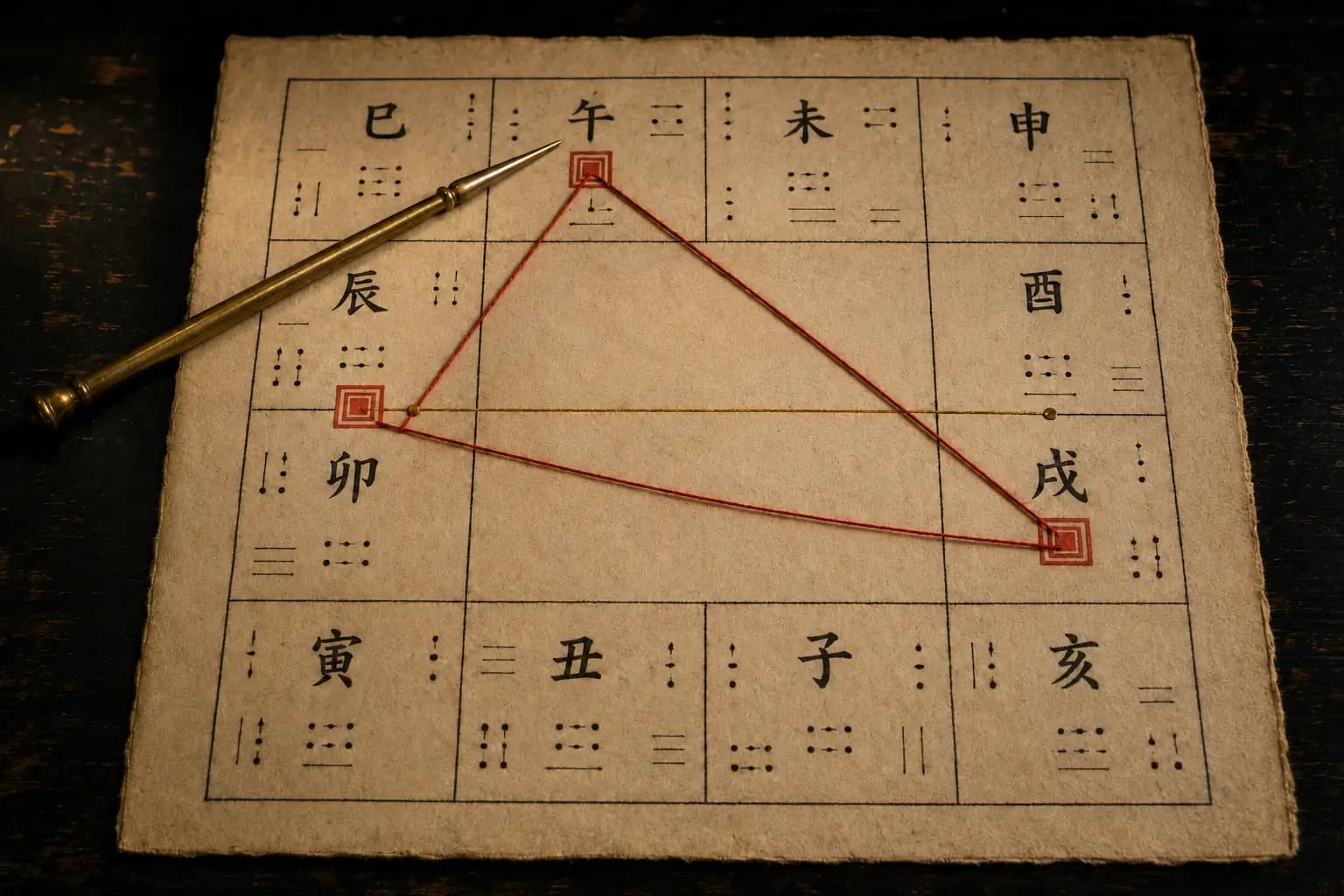
The twelve Earthly Branch boxes divide across the Five Elements as follows: Yin and Mao belong to Wood; Si and Wu belong to Fire; Shen and You belong to Metal; Hai and Zi belong to Water; and Chen, Xu, Chou, and Wei belong to Earth. By spatial position, the four corner palaces (Yin, Shen, Si, and Hai) form the Four Growth Palaces (Tứ Sinh), characterized by mobility, initiative, and travel; the four mid-side palaces (Zi, Wu, Mao, and You) form the Four Cardinal Palaces (Tứ Chính), characterized by clarity, focus, and peak intensity; and the four Earth palaces (Chen, Xu, Chou, and Wei) form the Four Storage Palaces (Tứ Mộ), characterized by consolidation, stability, and resource accumulation.
Layout of the information zones inside each palace box
Within each box on the Earthly Plate, the top header displays the palace's Earthly Branch, the uppercase name of the functional palace, and a Body Palace (cung Thân) marker if the Body Palace resides in that box. Immediately below the header sits the main line listing any resident major star (chính tinh), followed by supportive benefic stars aligned in the left column, challenging malefic stars aligned in the right column, and the starting age of the ten-year decade cycle along the bottom edge.
4. How do you read the elemental and polarity interactions between the Heavenly Plate and Earthly Plate?
Placing the Heavenly Plate in the center and the Earthly Plate around the perimeter allows the reader to evaluate how harmoniously the individual interacts with their broader environment. Before analyzing specific stars, experienced practitioners always check two foundational comparisons recorded right inside the Heavenly Plate.
These two comparisons act like the terrain profile of a long journey. When the terrain is smooth and supportive, the traveler covers ground with less friction; when the road climbs a steep grade, the chart holder knows to prepare stronger skills and steadier endurance.
Checking whether Yin-Yang polarity is in natural or inverse alignment
The first check compares the Yin-Yang polarity of the birth year's Heavenly Stem (thiên can) in the Heavenly Plate with the Yin-Yang polarity of the Earthly Branch box where the Life Palace sits on the Earthly Plate. A Yang birth year placed in a Yang palace (Zi, Yin, Chen, Wu, Shen, or Xu) or a Yin birth year placed in a Yin palace (Chou, Mao, Si, Wei, You, or Hai) is called Yin-Yang in natural alignment (Âm Dương thuận lý), which supports smoother adaptation to circumstances; the reverse pairing is called Yin-Yang in inverse alignment (Âm Dương nghịch lý), which often forge resilience through overcoming early friction.
Checking the generative or controlling relationship between Natal Element and Bureau
The second check compares the Five Elements phase of the Natal Element against the element of the Five-Element Bureau in Zi Wei Dou Shu. Configurations where the Bureau generates the Natal Element (Cục sinh Mệnh) or the Natal Element and Bureau share the same element in harmony (Mệnh Cục tỷ hòa) are highly supportive because the surrounding environment naturally nurtures the individual, whereas the Bureau controlling the Natal Element (Cục khắc Mệnh) introduces steeper environmental tests that reward disciplined specialization.
> Note: Never conclude that a chart is unfortunate simply because the Heavenly Plate notes Yin-Yang in inverse alignment or the Bureau controlling the Natal Element. Those lines describe only the baseline friction between person and environment; if the Life Palace, Body Palace, and active decade cycle on the Earthly Plate gather bright major stars and supportive benefic stars, the chart holder can still achieve remarkable success.
5. In what sequence should beginners read from the Heavenly Plate to the Earthly Plate?
To avoid feeling overwhelmed by more than a hundred stars scattered across twelve boxes, you should always read a chart from the inside out following a consistent sequence. The four-step workflow below is distilled from our step-by-step guide to reading a Zi Wei chart for self-directed learners.
Following a structured path from the Heavenly Plate to the Earthly Plate keeps your perspective balanced. It prevents the common beginner habit of spotting a single dramatic star in one corner of a palace and jumping to an exaggerated, one-sided judgment.
Step 1 and Step 2: Verify birth parameters and read the Heavenly Plate baseline
First, inspect the central Heavenly Plate to verify that the lunisolar birth date and hour were converted accurately, paying special attention to any leap month (tháng nhuận) or birth times falling in the Zi hour window (23:00 to 01:00). Second, read the Yin-Yang polarity, Natal Element, and Five-Element Bureau lines to note the starting age of the first decade cycle and whether decade cycles move clockwise or counterclockwise around the Earthly Plate.
Step 3 and Step 4: Locate the Life and Body Palaces and scan the Earthly Plate network
From the central Heavenly Plate, move your eyes outward to the twelve Earthly Plate boxes to locate the Life Palace and the box carrying the Body Palace marker, noting whether the Life Palace sits in the Four Growth, Four Cardinal, or Four Storage group. Finally, connect the Life Palace with the opposing Travel Palace (cung Thiên Di) and the two Three Harmonies palaces, namely the Wealth Palace (cung Tài Bạch) and Career Palace (cung Quan Lộc), before tracing the ten-year decade cycle numbers around the perimeter.
Key points
- The Heavenly Plate is the central panel recording birth timestamp, Yin-Yang polarity, Natal Element, and Five-Element Bureau.
- The Earthly Plate consists of the 12 surrounding boxes anchored permanently to the 12 Earthly Branches from Zi to Hai.
- The twelve functional palaces rotate across the fixed Earthly Plate foundation according to lunisolar birth month and hour.
- Always evaluate the Natal Element and Bureau relationship in the Heavenly Plate before analyzing individual stars on the Earthly Plate.
Would you like to observe the central Heavenly Plate and the twelve Earthly Plate boxes fully populated with stars for your own birth date and hour? You can generate your personal Zi Wei chart for free to practice reading each structural layer today.
Frequently asked questions
Why are the positions of the 12 zodiac branches on the Earthly Plate permanently fixed on every chart?
In Purple Star Astrology, the twelve boxes of the Earthly Plate represent the twelve compass directions of space and the twelve seasonal solar term (tiết khí) months of the year, so their coordinates remain invariant from Zi through Hai in a clockwise ring.
How does the Human Plate differ from the Heavenly Plate and Earthly Plate?
Classical manuals call the twelve fixed Earthly Branch boxes the Earthly Plate and the rotating ring of twelve functional palaces the Human Plate, whereas modern chart layouts combine both layers inside the twelve perimeter boxes.
Should I worry if the Heavenly Plate says Natal Element Controls Bureau or Bureau Controls Natal Element?
There is no reason to worry at all, because that line simply describes the baseline style of interaction between you and your external environment rather than dictating final life outcomes.
What are the Life Lord and Body Lord stars listed in the Heavenly Plate used for?
The Life Lord (Chủ Mệnh) and Body Lord (Chủ Thân) are two supplementary guardian stars calculated from the Life Palace branch and birth-year branch to provide additional insight into innate temperament and long-term spiritual grounding.
Sources
- Vân Đằng Thái Thứ Lang, Revised Zi Wei Dou Shu: Introductory chapters on the structure of the Heavenly Plate, Earthly Plate, Yin-Yang alignment, and Natal Element versus Bureau comparisons.
- Nguyễn Phát Lộc, Comprehensive Zi Wei Dou Shu: Explanation of the spatial geometry of the twelve Earthly Branches on the Earthly Plate and the Four Growth, Four Cardinal, and Four Storage palace groups.
- Chen Tuan (Trần Đoàn, Hi Di), Zi Wei Dou Shu Complete Compendium: Foundational rules for constructing the chart plates, determining the Five-Element Bureau, and placing stars by the lunisolar calendar.