The Water element (Mệnh Thủy) symbolizes fluid movement, intellectual depth, and adaptable resilience within the Five Elements (ngũ hành). Individuals born under the Water element belong to six Na Yin Five Elements (Ngũ hành nạp âm) types: Ravine Water (Giản Hạ Thủy), Spring Water (Tuyền Trung Thủy), Long-Flowing Water (Trường Lưu Thủy), Heavenly River Water (Thiên Hà Thủy), Great Stream Water (Đại Khê Thủy), and Great Sea Water (Đại Hải Thủy). They share a mutually generating relationship with Metal and Wood.
1. Which sexagenary birth-year pairs belong to the Water element?
Twelve sexagenary cycle (can chi) birth years belong to the Water element, arranged in six consecutive pairs across the sixty-year cycle. In traditional Eastern natural philosophy, the Water phase aligns with the northern direction, winter solar term (tiết khí) energy, and the nourishing currents that sustain life. To determine whether a person carries a Water natal chart (bản mệnh) element, calendrical calculation matches the Heavenly Stem (thiên can) and Earthly Branch (địa chi) of their birth year on the lunisolar calendar (âm lịch) against the sixty-year table.
Within the system of Five Elements and birth-year element classifications, the six Water Na Yin types appear across twelve sexagenary years. You can quickly look up your birth year in the summary table below.
| Na Yin Name | Symbolic Imagery | Sexagenary Pair | 20th Century Birth Years | 21st Century Birth Years |
|---|---|---|---|---|
| Ravine Water | Underground ravine stream | Bing Zi and Ding Chou (Bính Tý, Đinh Sửu) | 1936, 1937, 1996, 1997 | 2056, 2057 |
| Spring Water | Headwater mountain spring | Jia Shen and Yi You (Giáp Thân, Ất Dậu) | 1944, 1945 | 2004, 2005 |
| Long-Flowing Water | Long-flowing great river | Ren Chen and Gui Si (Nhâm Thìn, Quý Tỵ) | 1952, 1953 | 2012, 2013 |
| Heavenly River Water | Rain falling from the sky | Bing Wu and Ding Wei (Bính Ngọ, Đinh Mùi) | 1966, 1967 | 2026, 2027 |
| Great Stream Water | Rushing mountain cascade | Jia Yin and Yi Mao (Giáp Dần, Ất Mão) | 1974, 1975 | 2034, 2035 |
| Great Sea Water | Vast ocean expanse | Ren Xu and Gui Hai (Nhâm Tuất, Quý Hợi) | 1982, 1983 | 2042, 2043 |
Rules for identifying the Heavenly Stems of Water birth years
Within the sixty-year sexagenary structure, Water birth years are formed exclusively from three Heavenly Stem pairs: Jia and Yi, Bing and Ding, and Ren and Gui. Birth years whose Heavenly Stems belong to Wu and Ji or Geng and Xin never carry a Water Na Yin element.
If you want to explore the classical formula behind this grouping, read our guide to what Na Yin is and the full table of 30 Na Yin elements. Notably, the years Bing Wu 2026 and Ding Wei 2027 form the pair carrying the Heavenly River Water Na Yin element.
2. How do Still Water and Dynamic Water differ across the 6 Na Yin types?
The six Water Na Yin types span a wide spectrum between quiet, reflective stillness and powerful forward momentum: some resemble underground springs seeping through rock crevices, others gentle rain cooling open fields, and others great rivers surging toward the ocean. Classical texts distinguish these tranquil and dynamic expressions of Water to explain differences in personal temperament.
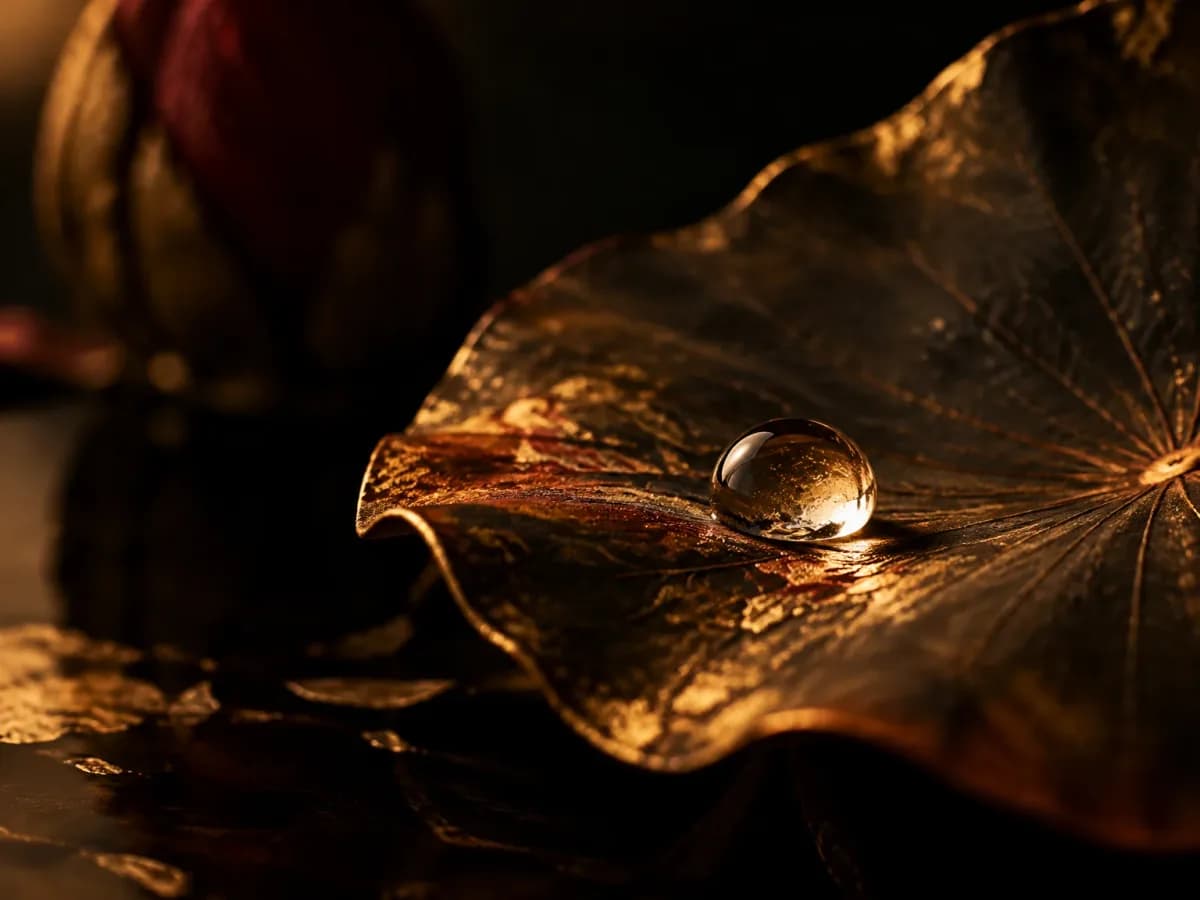
The clarity and gentleness of morning dew reflect the serene, perceptive inner life of Water element individuals.
Ravine Water (Bing Zi, Ding Chou) and Spring Water (Jia Shen, Yi You)
Ravine Water represents a stream flowing quietly beneath a mountain ravine or an underground vein of clear, unassuming water. People born in Bing Zi (1996) and Ding Chou (1997) possess a rich inner world, observe situations carefully before acting, and show deep sincerity toward close companions.
Spring Water represents a cool headwater spring bubbling out of deep forest rock, continuously renewing itself. Individuals born in Jia Shen (2004) and Yi You (2005) display strong intellectual curiosity, clear thinking, and a natural inclination toward specialized research.
Long-Flowing Water (Ren Chen, Gui Si) and Great Stream Water (Jia Yin, Yi Mao)
Long-Flowing Water represents a major river flowing steadily across vast territories before reaching the sea. People born in Ren Chen (1952, 2012) and Gui Si (1953, 2013) hold long-range ambitions and steady endurance, though they benefit from paying closer attention to immediate day-to-day details.
Great Stream Water represents a powerful cascade rushing down a high mountain valley with vibrant momentum. Individuals born in Jia Yin (1974) and Yi Mao (1975) are resourceful, quick to respond to changing conditions, and well suited to leading teams.
Heavenly River Water (Bing Wu, Ding Wei) and Great Sea Water (Ren Xu, Gui Hai)
Heavenly River Water represents rain falling from high clouds to nourish every living thing across the land. People born in Bing Wu (1966, 2026) and Ding Wei (1967, 2027) have an open-hearted disposition, strong empathy, and a talent for connecting communities.
Great Sea Water represents the vast ocean where a hundred rivers converge, holding the most expansive energy among the six types. Individuals born in Ren Xu (1982) and Gui Hai (1983) carry a broad, inclusive perspective and naturally gravitate toward large-scale endeavors.
3. How do flexible thinking and inner depth show in Water element individuals?
Water element individuals combine perceptive intelligence with diplomatic tact, adapting smoothly to shifting circumstances without losing their core direction. Within the Five Constant Virtues, the Water phase corresponds to Wisdom: clarity of mind and supple responsiveness.
Diplomatic listening and maintaining a steady anchor
Water element natives rarely resort to harsh confrontation; instead, they rely on attentive listening and persuasive reasoning to untangle complex problems. Thanks to this strength, they excel in diplomacy, commerce, strategic consulting, media and communications, research, transportation and logistics, and finance.
Because they are highly attuned to their surroundings, however, they can occasionally overthink. Developing the habit of writing down concrete action plans and setting firm completion milestones keeps their intellectual flow moving steadily forward.
4. When does the Water element need Metal support and when does it need Earth guidance?
When applying the Five Elements generating and restraining principles, each Water Na Yin type has distinct needs regarding Metal, Wood, Earth, and Fire. The table below summarizes how the three Water groups interact in practice.
| Water Na Yin Group | Interaction with Metal | Interaction with Wood | Interaction with Earth | Interaction with Fire |
|---|---|---|---|---|
| Ravine, Spring Water | Needs clean Metal to feed the source | Nourishes small and medium plants | Avoids heavy Earth blocking veins | Avoids overwhelming Fire |
| Long-Flowing, Great Stream | Suits Metal sustaining headwaters | Suits Great Forest, Pine & Cypress | Needs Earth embankments for direction | Forms Water-Fire completion |
| Heavenly River, Great Sea | Less dependent on Metal | Vital source for all Wood types | Unafraid of Earth restraint | Meets sunlight for scenic harmony |
Mutual generation with Metal and Wood, plus the guiding role of Earth
For Spring Water and Ravine Water, working alongside people with the characteristics of Metal element individuals keeps the headwaters clear and organizes ideas into structured plans. In the outgoing generation direction, collaborating with partners who embody the characteristics of Wood element individuals gives the flowing current a meaningful purpose in nourishing growth.
According to San Ming Tong Hui, Heavenly River Water and Great Sea Water do not fear Earth restraint because rain falls from the clouds and the ocean is vast. By contrast, Long-Flowing Water and Great Stream Water benefit from moderate Earth acting as riverbanks that channel their flow constructively.
> Note: In classical I Ching symbolism, balanced cooperation between Water and Fire forms the hexagram "After Completion" (Shui Huo Ji Ji), signifying well-ordered fulfillment. When Water and Fire individuals listen to each other, calm reason and warm enthusiasm complement each other remarkably well.
5. How can you apply the Water element to home interiors and personal Zi Wei chart readings?
To nurture mental clarity each day, Water element individuals can refine simple color and material details in their living spaces while cross-referencing their personal Zi Wei chart (lá số Tử Vi).
Choosing an elegant palette for wardrobe and home interiors
Following the guide on choosing element-compatible colors under the Five Elements, the signature colors of the Water phase are ocean blue, indigo, and black, while its generating Metal colors are ivory white, silver-gray, and light slate. In interior design, use warm white or light gray across roughly 60 percent of wall surfaces, pair it with 30 percent natural wood furniture to keep the room grounded, and reserve 10 percent for indigo accents on cushions or curtains under soft warm lighting.
Cross-referencing Water major stars on a Zi Wei chart
In Purple Star Astrology (Tử Vi Đẩu Số), the Water-phase stars among the fourteen major star (chính tinh) placements include Tai Yin (Thái Âm), governing finance and quiet refinement, Tian Tong (Thiên Đồng), governing gentle harmony, Ju Men (Cự Môn), governing analytical inquiry, and Po Jun (Phá Quân), governing pioneering reform. If you are born in a Water year and have Tai Yin or Tian Tong at Temple (Miếu) or Prosperous (Vượng) brightness in your Life Palace (cung Mệnh) under the Water 2nd Bureau (Thủy nhị cục), you inherit the calm, perceptive wisdom of the Water phase in full.
Key points
- The Water element comprises six Na Yin types: Ravine Water, Spring Water, Long-Flowing Water, Heavenly River Water, Great Stream Water, and Great Sea Water.
- Core qualities of the Water phase include perceptive wisdom, diplomatic communication, and rapid adaptability.
- Heavenly River Water and Great Sea Water do not fear Earth restraint, whereas great rivers need Earth embankments for direction.
- Water-friendly interiors favor a bright white or silver-gray base accented with refined indigo tones.
Want to see how your birth-year Water element interacts specifically with Tai Yin, Tian Tong, and the twelve functional palaces on your chart? You can generate your free personal Zi Wei chart for an accurate analysis based on your exact birth date and hour.
Frequently asked questions
What are the traits of children born in Bing Wu 2026 and Ding Wei 2027 under the Water element?
Both 2026 and 2027 carry the Heavenly River Water (rain falling from the sky) Na Yin element. Because Heavenly River Water cools and balances the active Yang energy of those years, individuals born in 2026 and 2027 typically combine an energetic presence with a kind, perceptive inner nature.
Is marriage between two Water element individuals favorable?
Two Water element partners easily understand each other's emotional nuances and rarely clash harshly. Both spouses simply need to establish clear financial plans and define concrete responsibilities when handling major household decisions.
Can Water element individuals use earthy brown or deep yellow tones?
If you belong to Long-Flowing Water, Great Stream Water, or Great Sea Water, incorporating warm wood brown or unglazed ceramic tones in moderation is very beneficial, helping your living space feel grounded and cozy.
Why do two people born in 1996 (Ravine Water) have different personalities?
The lunisolar birth year indicates only the shared Na Yin element, whereas individual personality is shaped by the specific positions of the Life Palace, Body Palace (cung Thân), and star combinations calculated from the exact birth month, day, and hour on a Zi Wei chart.
Sources
- Wan Minying, San Ming Tong Hui (Compendium of the Three Fates), Volume 1: Explanation of the six Water Na Yin types and the distinctive traits of Heavenly River Water and Great Sea Water.
- Xu Lewu, Zi Ping Zhen Quan (True Explanation of Zi Ping): Analysis of Metal-Water mutual generation and Water-Fire completion.
- Vân Đằng Thái Thứ Lang, New Compendium of Zi Wei Dou Shu: Meanings of the Water-phase major stars (Tai Yin, Tian Tong, Ju Men, and Po Jun) on the natal chart.